Showing posts with label genre. Show all posts

Make Your Own Haters

Not the famous poster,
but has Dejah Thoris.
I really wanted Andrew Stanton's John Carter to be good. And it's pretty good. It's not terrible. It deserved better than it got in the market, I think.

But I can see now what really holds it back from greatness. And it holds a great lesson for any GM (and plenty of other story-tellers, too). It's a lesson I myself have struggled to remember, time and again.

You just don't hate the bad guys enough.

And for a fantasy adventure story you need bad guys you can really hate. And in a fantasy adventure movie, you need to get to the hating right away. Your audience needs to HATE.

That's the lesson: a great fantasy adventure needs massively hatable bad guys.

Villainous Villains

Why is it especially important to get right to the hating in a movie? Because movies are really short, and they operate visually. Every second your audience spends trying to distinguish characters from each other is a second in which you've lost the opportunity to make them care. Important characters must be immediately distinguishable from others. Visually. We have to understand their relationships and our own feelings about them viscerally, not through explanation.

Let's compare the opening of John Carter with a couple of other films that I think are trying to tell similar sorts of stories, and did so magnificently: Star Wars and The Fellowship of the Ring.

Both of these films, like John Carter, start by setting up a large-scale conflict that will draw in our unsuspecting hero. Over the course of the story the heroes will come to take on the conflict as their own, and prove to be essential in its resolution. What's crucial, then, is that the audience care about the conflict. They need to be emotionally invested in the outcome of the conflict. And this has to happen fast, because, as I mentioned, movies are short. When you've only got a couple of hours to build that emotional investment, every moment of confusion or uncertainty in the audience reduces the potential impact of the story.

Done Right

30 seconds in, and you already know
who to cheer for.
The opening shot of Star Wars is rightfully one of the most classic openings in cinema history. Not only is it a fantastic technical achievement, but it tells the story right away. There's these scrappy little guys in some sort of ramshackle arrangement, and they're getting pushed around by these big bullies in this ENORMOUS HELLO I WILL EAT YOU spaceship. You know right away whose side you're on, of course, and that impression gets steadily reinforced as the opening scene plays out: kindly-faced Rebel soldiers looking worried as they get steadily gunned down by visored unstoppable soldiers, and then DARTH VADER appears all in black with a skull mask, and he murders some guy and then intimidates the plucky princess. Later on he will strangle some dude and BLOW UP A PLANET. And THEN he kills Ben. Jeez Louise.

We understand quickly that he's the bad guy, we hate and fear him immediately, and we are repeatedly shown reasons to continue hating and fearing him. We REALLY want Luke to get rid of this guy, even though it seems totally impossible. And we immediately recognize him later on, and we feel that hatred and fear without having to think about it.

One of the best things Peter Jackson ever did was to understand exactly who the bad guy is in The Lord of the Rings, and the opening of Fellowship makes it very clear. The battle between Isildur and Sauron, Isildur's moment of weakness at Mount Doom, and his subsequent betrayal, all of this tells us right from the get-go who the terrible trouble-maker is: the Ring. The Ring is bad, and we know it five minutes into the movie. We've seen it doing bad things, and we fear and hate it for the rest of the film.

Done Wrong

Basically identical to every
other guy in the movie.
So, compare with John Carter. Much like these movies, it opens with a scene depicting the larger struggle: in this case a battle between nearly-identical bands of flying soldiers. The leader of one group of nearly-identical soldiers is nearly identical to all the other soldiers, and appears no more competent or dangerous or hateful than the rest. Sure, he's killing people, but everyone in the frame is killing people, so...

Sab Than inspires neither fear nor hate. He's not doing anything that obviously needs to be stopped, and stopping him doesn't look any harder than stopping another random guy with a sword in a flying airship on Mars.

"But," you say, "Sab Than's not the real bad guy! This story is all about Matai Shang!"

Okay, so Matai Shang shows up, and yep, he's visually distinctive, at least. And he can apparently fly. And he gives Sab Than a big blue glove and says "This is awesome." So Sab Than tries to blow up Matai Shang with it, and nothing happens.

So that's not very impressive. We're still left with no real reason to hate Sab Than or Matai Shang, and Than's foolishness only makes both of them even less fearsome.

And Matai Shang changes appearance constantly through the movie, which undermines the point of his distinctive appearance. The whole point of giving a primary character a distinctive appearance is so that you can steadily build up an emotional association in your audience. When they see him, they see him doing something awful, and they hate him even more than they did before. They build an association between that feeling of disgust and his appearance.

Every time he appears in some other guise, that association is made less intense. So Shang's constant shape-changing undermines what's already a problem about this film -- our lack of emotional investment in the conflict of which he is a part.

And Shang never appears to do anything all that terrible, anyway. Nor does Sab Than. Oh sure, there's killing guys, but war is hell, right? And there's TALK about vague, terrible things, but we don't SEE any terrible things, so we don't develop any association between these characters and a sense of disgust or hatred. They're not blowing up planets and torturing plucky princesses. They're not corrupting brave warriors or whispering to Ringwraiths. They're not doing much of anything, it seems.

The Lesson

I'm not trying to hate on John Carter. I like the movie. Stanton's takes on both Carter and Thoris are fantastic, and both actors do a great job bringing two of my most beloved characters to life. The action scenes are well-played and the Tharks are other beasts are awesome.

But this is an instructive lesson, I think, for storytellers of all stripes, including GMs. It's hard to create truly memorable villains in an RPG, since so many games are crafted around the idea that the players will win every encounter. That means that upon meeting the bad guy, they will defeat him, and so there's rarely much of a chance to really build up that sense of hate and fear.

But how do you introduce bad guys, get your players to hate and fear them, without making it an immediate fight to the death? How do you delay the action of justice so that it's all the more satisfying when it happens?

One of my most memorable bad guys was an accountant. There's something about accountancy that helps keep players civilized, maybe.

I often outright tell my players to not try fighting a bad guy out of their weight class. My reasoning is that the characters are receiving far more non-verbal information than I can give the players, and so they have access to an understanding the players do not. So if I say, "You're very sure this guy will beat you all to a pulp if you look at him sideways," that's just their characters understanding some cues that are hard to express through the sort of narration available to a GM. Once the players are willing to let the scene play out, I find it much easier to build up bad guys they can really hate.

But are there better ways to do this? Do some games handle this better than others?

Fiasco: Adrilankha

So this fascinating game Fiasco has been popping up all over the place on my radar recently.

Made by Bully Pulpit Games, it's a GM-less story-telling game that attempts to produce the sort of knotty caper flicks well-typified by the work of the Coen brothers: Blood Simpler, Miller's Crossing, The Big Leibowski -- stories of characters with, as the game tagline says, "powerful ambition and poor impulse control."

So the game is built up using what are called "playsets", which are basically sets of story elements -- relationships, needs, objects, locations -- that the players assemble at the start of the game in order to kick off the story. A given playset reflects a particular genre or setting. So there's playsets that enable stories in modern suburbia, or a luxury liner in the 1920's, or the Old West, or Ming Dynasty China. Very cool stuff.

What I find really cool about this is how easy it makes it for folks to create new material for the game. There's no need to reproduce any copyrighted material in order to create a playset -- no rules, no stat blocks, nothing. Just lists of story elements, organized into groups of six. So they publish a new playset every month, written by all sorts of different people.

Being me, I immediately wondered about a playset I could create, cause I don't really get excited about playing a game until I've sat down with a page layout program and built myself some forms or something. I thought about various caper stories I loved, and realised that a lot of them had been written by the wonderful Steven Brust, and were set in the imaginary capital of his imaginary Dragaeran Empire: Adrilankha.

So that's what I used. It's a very narrow-appeal sort of playset, since only die-hard Brust fans will have sufficient background on life in Adrilankha to be able to build a game there, but it pleases me. I was able to get Devera into it, of course, and it includes a number of deep in-jokes if you're a fan of the Vlad and Paarfi tales.

Download the playset and check it out!

Settings: for fiction or gaming?

It's been a truism of my experience that many of the settings that I love from fiction aren't particularly well-suited for roleplaying, and settings that are great for roleplaying aren't necessarily well suited for fiction.

I don't know if this is a true truism, or just an artifact of my experience, though. Certainly plenty of folks have loved roleplaying in settings such as Middle-earth, Star Wars and others, and both TSR and later Wizards of the Coast have popular and profitable novel lines set in their most popular roleplaying settings such as Dragonlance, the Forgotten Realms and Eberron.

I do think that there are some characteristics of a good roleplaying setting and a good fiction setting that set them at odds with each other, though… perhaps making a great setting for one venue poorly suited for the other, at least without a fair bit of work to shoehorn elements in that may not have been there originally.

The most obvious element is that a good roleplaying setting demands a certain level of stasis. It's difficult to find a great roleplaying game in the Star Wars setting in the midst of the Galactic Civil War, which is technically the setting of the original trilogy of movies. Why? Because the best, most crucial, most transformative stuff is being handled by a bunch of NPCs. Luke and Han and Leia and all those guys; they're the ones leading the fight to bring down the Empire and usher in an era of freedom. In the face of that, any game characters played by your group are stuck playing second fiddle.

There are workarounds, but none of them are easy. You can run an alternate history game. You can say that Luke and Han and Leia never happened, or never amounted to much. Leia was never rescued by Luke, because the droids were shot down out of their escape pod after all. Luke went on living a peaceful yet unsatisfying life as a moisture farmer. Han kept smuggling for Jabba until he either sorted out his differences, or bit off more than he could chew and ended up on the butt-end of some bounty-hunter's blaster. Meanwhile, the stolen Death Star schematics somehow came into the hands of the PCs… who now have to be the leaders of the Resistance themselves. Is Star Wars just as compelling a story if it has different characters; different actors?

Or, you could separate them from the movies in time or space. The Knights of the Old Republic roleplaying games for the Xbox and PC did this by going back in time some 3,000 odd years, and essentially rebuilding the Star Wars setting from scratch. This is a satisfying exercise if you enjoy tinkering with settings and putting your own stamp on them (I do) but it's a lot of work, and goes a long way towards defeating the purpose of using an established setting in the first place. To be better suited as a roleplaying setting, the setting needs to be more static; waiting for the PCs to put their stamp on it.

Oddly enough, I don't think a lot of people who use static RPG settings really take advantage of letting the PCs put their stamp on stuff. I think a good setting also needs to be vibrant. If there's an implied threat; one nation is wanting to invade another, it's kinda lame that that threat just sits there statically while the PCs are off doing something else entirely. All too often, the PC's actions are nothing more than maintaining the status quo in the face of bad guys who want to change it. I tend to rather like big plots in my games. Invasions, death and succession, game-changing events of various stripes; that's the stuff a lot of folks like in their fantasy novels, why not in their games too? Of course, this means published, static settings are going to be less useful, as you're going along making all kinds of changes to them.

Of course, I almost never use published static settings. For this very reason.

That said, I think there's also an undervaluation of the "small" campaign, both in fiction and in roleplaying games. Why do we have to always "save the world?" Why do we have to do anything big at all? Why is that a feature of the fantasy genre, both in gaming and in fiction?

I honestly am not 100% sure. Another genre I like to read is mainstream thriller stuff. Y'know, Robert Ludlum, John Le Carre, guys like that. Although sometimes they do huge, game-changing type of events, mostly they don't. The success or failure of their protagonists are just one more statistic in the tapestry of the real-world setting. Sometimes, yeah, there's resurgent Nazis, the threat of nuclear destruction, or other things like that, but mostly the changes that happen in this genre are small. That doesn't make the stories they tell any less exciting, dramatic or moving, though.

Anyway, I feel like I'm reaching the stage of my post where I'm starting to ramble, so I'll leave off and leave the question open-ended for the peanut gallery. What makes a setting good for roleplaying? What makes a setting good for fiction? Can the same setting serve both purposes equally well?

Creating "That Feel"

A mountain fastness by Claudio...In one of my earliest campaigns (Hi Glenn!) my co-DM and I decided to send our party to an "alternate universe".

Hey, it seemed like a pretty cool idea in 1985.

Anyway, we'd run a few sessions in this new world when Glenn came to me and said, "This isn't working."

"What?" I said, "It's going great. They're all after the paintings, and we've got this whole dungeon worked out..."

"No, no. That stuff's all fine. It's the universe. It's no good."

I was mystified.

"It's not DIFFERENT. They're in ANOTHER UNIVERSE, but it just feels like the same old same old. Same monsters. Same weapons. Same everything. We have to make it different."

We did a bunch of stuff: we changed the technology so that the primary weapon types were different, we drew a new map with new place names and we changed a bit of the window-dressing around magic. We threw out all the existing monsters -- and Glenn figured out we could use the same statistics for a critter but completely change its description, so the players would have no idea what they were fighting.

But the best thing we did was we changed the names.

It was not entirely successful, since we hadn't put much thought into the names of the "original" universe, so it was the usual fantasy mish-mash of Latin-sounding, Anglo-Saxon stuff with lots of vowels for the elves. And lots of "K"s for the dwarves.

But for this world, we made up naming conventions for the different places. Inspired by a Dragon article, I came up with phoneme collections for the various locales, so that Osgipur names would be mostly generated from "ur"s, and "gip"s and whatnot, while Maeloch names had "och"s and so on. It sounds goofy, but at the time it really helped us deliver the idea that this place was all new to our heroes.

Creating a world is one of the things I find most exciting and rewarding about being a DM. You want to instill a sense of wonder in your players, but it's so easy to get caught up in grinding hit points, positioning and buffs and all that tactical stuff, that the "window-dressing" can get given pretty short shrift. Which in small doses isn't such a bad thing; you don't want to interrupt every action in combat with a discussion of how unusual the architecture is around here. But if too many sessions go by without that sort of ambience or flavour, your game starts to lose the unique spark that got your players excited in the first place.

I've always found names to be far and away the most useful way to establish the sort of atmosphere I want. Like Robert E. Howard, I make use of existing cultural associations to evoke particular ideas in my players. My scheming manipulators had Italian-sounding names while the imperialistic worshippers of a god-king sounded Egyptian. And I mix it up; my nomadic horse tribes used Aztec names. When running a campaign, one of my most trusted tools is a few pages of names for all my cultures, so that if I have to come up with an NPC on the fly, they'll have a name consistent with their origin.

You can go too far with this sort of thing, of course, and see your setting descend into mere cartoonishness, but I've always found that distinctive naming conventions the single best way to make my campaigns stand out. Probably why I still have this soft spot for Exalted, even after some very painful efforts to actually play it. Some cool-ass names in Exalted.

Too Slow! But I Don't Care

The Mad Pulp Bastard beat me to it, but the second I saw these I thought, "I would so read every issue and wait in the bookstore for next month's to arrive."

I mean, damn. I can remember spending hours lying on my stomach with a pad of paper and some coloured pencils, drawing scene after scene of cool planes blowing stuff up. This is what is best in life. Damn.

What a great imaginative boost these images are. I gotta fire up that WWII d20 Modern game I was thinking about. You know, the one where they parachute into Italy, and have to make the rendezvous with the sexy Resistance agent who leads them to the bridge that they MUST secure or the entire Allied advance is going to come to a crashing halt? Yeah, that one...

In other news, I'm off to Gryphcon in a couple of weeks to run a new DINO-PIRATES OF NINJA ISLAND game -- only a couple of slots left so if you're gonna be in Guelph, sign up! I'll also be running a few games at Anime North in May. Shaping up for a busy spring!

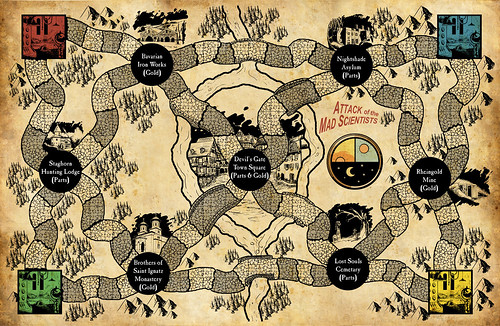
Attack of the Mad Scientists!

Those of you who know me know that the bulk of my work is for those crazy Canucks at Fiery Dragon. For the past two months I've been doing work for their line of boardgames, the latest of which is the sure-to-become-a-classic "Attack of the Mad Scientists!

AotMS's author, David Cuatt, posted on the Nerdabout New York blog some looks at the different stages of the game's production, from sketch to cover. And what a cool game to work on!

The map has an old parchment texture, while the cover was made to resemble some of those old horror movies (with a name like "Attack of the Mad Scientists", how could it be anything else?).

So head over to Nerdabout New York and enjoy!

Sun, Not Rising

Great science fiction asks us to think about the very concept of being human, of the human experience. Arthur C. Clarke, Isaac Asimov, and Robert Heinlein all took their readers on investigations of what being human really meant, by asking unsettling questions of the type "What if (insert basic assumption about life here) were no longer true?" Asimov's Robot stories ask us to consider if our biology is central to our humanity. Clarke's amazing Childhood's End challenges us to imagine a humanity no longer limited by our need to live on this planet.

Karl Schroeder's remarkable "Virga" novels are asking some very unsettling questions, and providing very few settly-type answers.

His latest book, The Sunless Countries, his fourth set in the bizarre landscape of Virga, pretty much asks the question, "What if animals could use physics simulators? What if a dog or a wildebeest could provide itself with artificial augmentations? What the heck would THAT look like?"

Which is just a pretty nutty question to even ASK in the first place. I mean, what?

So there's characters appearing in this story who can talk, who can make use of completely over-the-top technology, but who aren't sentient. It's a bizarre conceit, made possible only by Schroeder's vision of where technology is leading us: towards the capacity to perfectly model natural processes. When this capacity is trivial to provide, argues Schroeder, we no longer need reasoning to provide us with advancements -- we can simply model natural selection, accelerate it even, and the improvements we desire will be made apparent to us. Once this technology becomes all-pervasive, then any entity capable of desire becomes capable of transforming itself, of developing whole new forms of technological marvels. Entities do not need to realise this is what they're doing. They don't need to possess awareness, just desire. Just hunger. Science itself becomes obsolete when the model's predictive power is faster, more reliable and more available to all.

(that'll really piss off Glenn -- I hope he reads this)

Except of course that reasoning, coupled with imagination (and perhaps given structure via constraints) can always envision solutions BEYOND what the model is capable of predicting, of making leaps the model cannot make. And it's becoming clear that the story of Virga is the story of the last enclave of life that is directed by scientific reasoning and human imagination. Everywhere else, we are learning, has been overtaken by this "artificial nature" that provides everything to everyone according to their desires. Only in Virga do people still puzzle out solutions to their problems. And because of this, Virga is both desired and suspected. How this will all play out is yet to be learned, but Schroeder is telling a fast, compelling story that only reveals its secrets in small doses. Just enough to keep you dying for more.

Perhaps Schroeder is preparing an elegy for science, or a last desperate plea for a beleaguered mode of thought. It's been forty years since the Moon missions. Creationism gets argued for in international media. And science fiction has been struggling without a great visionary voice for decades.

Now it seems we have writers like Charles Stross and Cory Doctorow championing a new, positive vision of the world ahead, something at last tearing down the cyberpunk dystopia that overtook everything in the 80's and erecting in its place a bizarre new world, crazier than the craziest Amazing Stories cover from the days of Hugo Gernsback. Karl Schroeder is staking out bold new territory in this space with giant bubbles of wine, flying icebergs and balloons orbiting distant stars.

And a creepy yet compelling discussion of what "human" means -- even more, what does "sentience" mean and why should we worry about it?

Conspiracy Mashups!

I can't quite recall WHY I read Illuminatus! (or more properly, The Illuminatus! Trilogy).

Steven King may have referenced it in Danse Macabre (still my favourite of his books). It may have gotten mention in Dragon magazine way back in the day.

In any event, my 1984 Dell printing was pretty much brand-new when I got it, so it was a good healthy number of years ago. It was like reading a nuclear explosion. I was sixteen years old, and the most challenging stuff I'd read up to that point was probably A Tale of Two Cities. I didn't know anything about drugs, about hippie culture -- I barely knew anything about politics and certainly didn't get more than the barest number of the thousands of references scattered through this bewildering -- but hilarious -- novel. Shea and Wilson basically invent the conspiracy theory tale in these 800-some pages (and apparently that's with 500 or so pages cut out) and none of their imitators in the decades since has even approached the invention and audacity that makes this book so overwhelming.

Geez, was that all one sentence? Whoa.

"It was the year when they finally immanentized the Eschaton." What kind of opening sentence is that? The constant switching of narrator voice -- at points it's actually impossible to tell anymore who's speaking, and what point of view we're supposed to think they're presenting. Which is of course half the point. The book itself is a mammoth conspiracy tale, and like any good conspiracy, includes plenty of truths and half-truths in amongst the outrageous lies. And on page 722, the greatest joke of it all, the fourth wall gets blown away (is there a fourth wall in books?), and I the reader get pulled right in on the whole joke and it still works.

Like most genre-defining works, I think Illuminatus! actually reaches and even exceeds all the boundaries it creates. This book goes as far as any conspiracy book can possibly go, and then goes farther. There's really nothing left to write here - the spawning point is also the graveyard.

But there's something else that this mad tale has left us: the mashup. Because a conspiracy theory always has to be a mashup. The whole point of a conspiracy theory is to assert the connection between elements that otherwise do not appear to share anything. When George Dorn gets told that Abdul Alhazared, George Washington and the assassination of John F. Kennedy are all related to the ancient rulers of Atlantis, THAT'S mashup happening. The more elements you can tie together, the less probable your whole edifice becomes, the BETTER. And sometimes it seems like the mashup has become the default genre. From Kill Bill to The League of Extraordinary Gentlemen to, um DINO-PIRATES OF NINJA ISLAND, everywhere the mashing together of genres and massive "referentiality" are making up wholly new paradigms. Nowadays everyone knows what "steampunk" is, but fifteen years ago? Not so much. But it hasn't taken very long. Only five years back, the suggestion to "Define some genres" resulted in creative hilarity, and all of the genres defined therein count as mashups -- from "Trucker: The Cavalcade" to "Lovecraftian Ringwaldpunk".

I think all this fun stuff really does owe a big debt to Shea and Wilson's mad, psychedelic vision of the late 60's. Reading those dense paragraphs of lurid sex, violence, drugs and utter insanity (I'm making it sound pretty awesome, aren't I?) was and remains an absolute trip. This book is amazingly smart, amazingly well-informed and structured so beautifully it's almost impossible to see it -- the whole thing just flows from start to finish in a single uninterruptible stream. Crazy.

And the book remains one of those books that EVERYONE has heard of (or at least is familiar with the concepts it invented), but surprisingly few people have actually read. I don't think it quite qualifies as A One Nobody Knows, but sometimes it seems that way. But regardless, the idea of mashing together random references from history, pop culture and science has become an entire field of genres. Practically every comic book published nowadays owes a debt to this book, and plenty of Hollywood's output, too. It's definitely, in the words of Nuclear Platypus, "a real slobberknocker".

And if you don't get that, you haven't followed enough of the links I've so thoughtfully provided for you in this post. C'mon, start connecting some references here! Everyone's doing it!

We Begin With

Bill Cunningham, Agent of Pulp, comes through with one of the most amazing things I've ever seen:


If I'd been there, my brain would have exploded with sheer delight. People are just so awesome. I mean, these folks went to a LOT of trouble to do something that serves no purpose other than to amuse and delight their fellow humans. That is the Angel of Joy, at work right there.

Now it was Justin who turned me on to 2D Goggles: The Thrilling Adventures of Lovelace and Babbage, which you MUST read and slaver over. As I'm basically a drooling fanboy for all things Ada Lovelace, this actually DID cause my brain to explode. Thanks, Justin.

But look: Ada Lovelace and Charles Babbage invent the computer and FIGHT CRIME. Ada's the smart, sassy one who crawls around in the depths of the ginormous Analytical Engine, fixing bugs (with a wrench), while Babbage is completely insane. It's brilliant, it's hilarious, and you should go read it right now.

The world is getting positively crowded with folks who do great things and don't try to squeeze every possible cent out of their audiences. Not that dancers and comic-book artists shouldn't get paid -- Cunningham has all sorts of links, thoughts and advice to creative types on how to GET PAID. But at the same time, if you're not having fun with it, if you aren't able to sometimes just do something because you LOVE IT, what the hell? Go get a job, kid.

Look there on the right. That's Yumi. Yumi's crazy, and she talks to ghosts. You're going to meet Yumi and her friends in the near future, but Claudio did that picture of Yumi because he likes her. DINO-PIRATES OF NINJA ISLAND is meant to create opportunities to get paid, but it's also meant to be fun, and if all it ever does is provide delight to others, I'll be well-satisfied, I can tell you that.

Although I'll still wish I'd seen that dance number in the train station. That was brilliant.

Story Hours

Re-edited, revised and re-posted from another blog, where I originally made this post before.

"Story Hours" are an interesting phenomena, particular to ENWorld, the premiere website and discussion forum for Dungeons & Dragons. It's an interesting concept; the whole "let me tell you about my campaign" writ large. Because the web as a forum is only semi-sensitive to audience reaction, it's possible for people to say an awful lot about stuff that you wouldn't be able to in regular conversation. Huge info-dumps, even.

This is how the "story hour" idea started; people wrote and posted logs of their games; what happened, in blow by blow detail. This later "multifurcated", if that's a word, into a number of styles. Some people use story hours as fairly sparse shorthand for what happened. Some people elaborate with recitations of dialogue, NPC vignettes, and other things that make the form more closely resemble "regular" literature. Some people are very strict about only including exactly what happened in game. Others are writing long after the fact, and are recreating from vague memories the details of the game in broad strokes.

In any case, a "market" for "story hours" developed at ENWorld to the point where a subforum was created specifically to cater to them, and some story hours have become big draws for the site.

One that I've always enjoyed is drnuncheon's Freeport Story Hour, a recitation of a playthrough of the original third edition Freeport Trilogy, and an interesting exploration of the setting, and urban fantasy gaming in general. In fact, when I've been asked (and it's come up a few times) how to do a successful urban fantasy campaign, one of the first things I do is point them to this story hour. It's a great example of a successful campaign set in a fantasy urban environment, where the adventures take place (often) within the city itself, instead of out in a "dungeon" somewhere. Since I strongly dislike the dungeon environment, this story hour piqued my interest more than most; urban intrigue is my personal bread and butter.

The story hour is also very breezily written; it settles into a more of a "semi-novel" style after a short stint as more of a "players log", with dialogue and good descriptions of action, and relatively few intrusive "gameisms" in the narrative. The author then does go on in other "out of narration" posts to give some interesting game info too. I could recommend a number of story hours---I've always been partial to barsoomcore's various efforts (of local fame, here on this very blog) for instance, and I've yet to meet anyone who didn't like jonrog1's or PirateCat's story hours---but for today, drnuncheon gets the honors of being recommended. I strongly suggest you check out the Dr.'s efforts.

In any case, I find the concept and phenomena of Story Hours fascinating; it's a new kind of writing that probably doesn't appeal to everyone, but to its target audience, it offers a genuinely unique experience. It also converges with some fantasy writing. A number of fantasy writers over the years have hinted that their novels and stories have evolved out of a gaming milieu (Raymond Feist, Steven Erikson, etc. I'm sure there's more that I can't think of off the top of my head) and this more direct tie to the hobby is, as I said, a very interesting phenomena.

Battleships, Communists and Demons

We went to see the classic Eisenstein film Battleship Potemkin last week at the Cinematheque.

We'd seen it a couple of times on video, as much out of a sense of duty as anything. I mean, you HAVE to watch Potemkin. You HAVE to. What are you going to do when you're talking to REAL cinema fans and they start talking about it? Fake it? Come on. You HAVE to watch Potemkin.

Anyway, seeing it on video is woefully inadequate preparation for seeing it on the big screen. It was a SHATTERING experience. One of the most exciting films ever made, still. Ranks up there with King Kong. Bad-ass.

I defy anyone to watch that film in the theatre and NOT come away going, "I wish I could join the Communist Revolution and take back power from the capitalist overlords!" It's such an emotional argument -- it's impossible to debate Eisenstein's overwhelming enthusiasm for the revolution and all it means to the downtrodden and hopeless. But at the same time, it was interesting to note for the first time how the enemy of the revolution gets steadily less and less "faceful" as the story moves onwards and outwards.

When it's just the sailors on the battleship mutinying, the bad guys are clearly outlined for us: the arrogant captain, the sneering ship's doctor. We see them clearly and their downfall is a triumphant moment. The next round of villains (aside from the sneering facist whose calls for racial cleansing are spurned by the fair-minded brothers and sisters of the revolution) are the Cossack soldiers, marching in line down the steps, their uniforms identical, their steps perfectly cadenced, their faces never shown. They are the mass -- the undifferentiated human product of capitalist society, put to mechanical work serving their masters at the expense of the proletariat. Who are NOT undifferentiated but made up of one individual after another, Eisenstein is very clear about that.

The Cossacks are much less individual than the ship's officers were. And the final villains of the piece are even more so -- they're never even shown at all. The crews of the oncoming squadron are never on screen. All we see are the ships pumping smoke and churning up the sea, until at last the triumphant conclusion overwhelms all else and the proletariat revolution takes over the globe.

Which is I think the problem -- Battleship Potemkin is an illustration of the Communist religion dealing with the question of evil. If the revolution is inevitable everywhere, and if everyone will eventually see the truth and light of the socialist way, then nobody's really AGAINST us, are they? I mean, IF we're right, then ultimately EVERYBODY is on OUR side, so who are we supposed to fight? As the scope of Eisenstein's revolution expands, his villains MUST get more and more indistinct, less and less human. Because it's very difficult to justify running around killing other humans if they're really going to be on your side in the end.

Which now brings us to demons and the problem they present.

Basically, demons are a convenient tool for telling stories, because you can have your heroes slaughter them remorselessly for hours on end if necessary. Nobody has to feel bad, cause they're demons. They're inherently EVIL. They DESERVE to die.

Ah. Deserve.

But in the end, what does "inherently evil" even mean? Does it mean they just do cruel things all the time, like torture puppies or talk in movie theatres? Are EVIL creatures just big meanies?

Well, it has to be more than that. Cause it's not okay to run around killing people just because they're mean. So maybe "inherently evil" means "incapable of good". Okay, so whenever given a choice, a demon does the evil thing. Which gets retarded almost immediately -- whenever somebody's talking to the demon, the demon punches them in the face. Or stabs them. This must make demon-to-demon communication kinda hard. But if the demon sits and listens politely, even if he's planning to do something really horrible later on, he's still doing something NOT evil right now. If he happened to fall off a cliff before his evil plan came together, the person he was talking to would think, "Gosh, that demon sure was a nice fellow. I'm going to be nice to kittens from now on." and suddenly the world is a better place because that demon was in it. Which means that running around killing demons "just because" actually might be a bad thing, because the demon might inadvertently be just about to do something good just when you kill him, and thus your killing him is an evil act.

Whoops!

Eisenstein gets around the Demon Problem in the time-honoured fashion of dehumanizing his revolution's enemies. Many fantasy authors and game settings take a half-baked philosophical approach and pretend you can coherently imagine creatures of pure moral constancy. I prefer my demons to just be people. People who maybe aren't very nice, maybe aren't very concerned with other people, but who are people acting for people-like reasons. It may be less exciting, but well, it may not be.

Thoughts on Communism, revolutions, demons, and cinema? When designing a setting either for a game or a story, what sorts of choices this way do you lean towards?

The Jukebox Heroes

A while back DC Comics had the Milestone imprint, which featured characters like Static (of Static Shock fame), Icon and Hardware (they were all recently incorporated into the main DC universe). So I recently learned that one of the Milestone characters is a girl in a winged iron armor who calls herself Iron Butterfly (if you didn't catch that, hang your head in shame and check out Wikipedia).

So that obviously got me thinking (as these things are wont to do). And since nothing good ever comes out of thinking...

The Jukebox Heroes:


  • Robert, a sentient plant.

  • War Pig, an iron-clad wereboar.

  • Deaf Leopard, sharp-clawed, keen-sighted berserker. Not really deaf, just stubborn.

  • White Snake, beautiful female shaman.

  • Poison Sticks, silent wielder of the twin viper rods.

  • Concrete Blonde, a hot woman who could turn into living rock.

  • Wayward, a drifter marked by celestial powers.

  • JoAnne Jet, superfast girl who loves a battlefield.

  • Holy Diver, a time-displaced barbarian warrior.

  • The Foreigner, the alien that brought the Jukebox Heroes together.


In their helicarrier, the Lead Zeppellin, they fight whatever menace threatens the freedom of the world's youth. They fight menaces like Zig, Master of the Stardust, and his Spiders from Mars; Thriller and his Undead Horde; Burning Heart, the Unquenchable.

And the mega-plot is the fight for the icon of ultimate cosmic power known only as the Eye of the Tiger.

Picture by HopePhoto

Ninja Girls of the Reform School

So I've finished up a draft of what I hope will become a comic book someday:

REFORM SCHOOL NINJA GIRLS

It's of course set in the world of DINO-PIRATES OF NINJA ISLAND, and much like that setting itself, started out as a sort of joke that I, in my pedantic fashion, took perfectly seriously and tried to elaborate on.

This is much how my brain works: somebody says something completely insane, and I think, "Hm. What would that be, if you assumed it was actually as advertised?"

So if there were in fact DINO-PIRATES, what would they be? And what on earth is a NINJA ISLAND? (aside, obviously from an island full of ninjas, but don't we already call that "Japan"?)

These are the sorts of questions that keep me up late at night. Unlikely to cure cancer, I know, but there it is.

So when it was proposed that a story about ninja girls in reform school would be a worthwhile notion, I considered it long and consideringly. Well, for about a half-second, then I said, "But what do we call it? NINJA REFORM GIRLS' SCHOOL? REFORM GIRLS NINJA SCHOOL?" This stuff is harder than it looks.

I was stumped. And to tell you the truth, I'm not sure who actually came up with the proper arrangment of words though I suspect it was either Matt or Jody. But there it was: REFORM SCHOOL NINJA GIRLS. And once the formulation was in place, my brain took over, doing the things it does, and asking questions like, "Who would send ninja girls to reform school? What would need reforming and why? And should they wear ninja outfits or schoolgirl outfits?"

The first incarnation of RSNG was a game I ran twice at GenCon 2008. I needed seven characters, so I based them all on women I had known in Japan: Masayo, plucky and cheerful and nobody's fool; Ayako, sweet and good-natured and always hungry; RItsuko, hilarious, always laughing and building robots; Kaori, the singer in a Judas Priest cover band; Eri, one of the greatest swordspersons I've ever known; and Yumi -- who was very sweet and completely insane. To these six I added Millicent, because the idea of a stuck-up English girl amongst these ninjas made me laugh.

The whole thing has to be played totally straight. Everything about DINO-PIRATES is meant to hold together without too much suspension of disbelief required.

Yes, I actually wrote that.

And I MEANT it, darn it all. These girls are REAL (sort of), and their story has to be real if it's going to be worth telling. Things are going to be hard for them and they're going to struggle to get through this. I'm writing six issues which will culminate in the battle royale that the GenCon 2008 adventure described, with pirates, robots, hopping vampires, sinister agents and possibly even fire-breathing monsters. The games at GenCon were fantastic illustrations of what can happen when everything goes right at the table, and inspiration builds on inspiration, but a one-shot game just can't have the history and weight that a lengthy story can acquire, and as much as I love running games, there are story-telling itches it just can't scratch.

I wrote my Barsoom Tales story hours as a way to scratch that itch in the fall-out of that game, and to bring to the surface some order around the story that had most captivated me in its first two seasons. REFORM SCHOOL NINJA GIRLS is sort of the same thing -- but this time wanting to go back in time and watch how we got to the wild craziness of that final conflict.

The first issue features flying through the air, giant tentacles, benches, decapitations, and plenty of wild ninja action. Currently our very own Claudio Pozas is having a look to see if he thinks he can find the time in his busy schedule to pencil this baby, which obviously would be ideal, as Claudio has been the artistic vision of DINO-PIRATES OF NINJA ISLAND from day one.

Stay tuned! REFORM SCHOOL NINJA GIRLS is coming your way!

Green Lantern Trailer

Okay, this is insanely awesome. I'D totally go see this movie. Too bad it doesn't exist.

Japanese Horror: The Transmission of Suffering

The great explosion in a genre that can only be called "Japanese Horror" began back in 1998 with the little film called The Ring, by Hideo Nakata. And a little girl crawling up out of a well, and occasionally out of other things little girls have no business crawling out of.

Recently I watched one of the more unlikely follow-ups to Nakata's enormously successful film, Hair Extensions. Yes, this film is in fact about murderous fashion accessories. It's creepier than you might think, and a great performance from Chiaki Kuriyama gives it a weight it wouldn't otherwise earn. But it got me thinking about the phenomenon of Japanese Horror, and in particular how these films differ from, say, western horror films.

Now, in any successful horror film, it is clear to the audience that by the end of the film, judgement has been handed out. Those who died horribly may not have "deserved to die" in any realistic fashion, but the audience understands that they broke the rules and they must pay the price. This is a basic truth of all horror films -- they are reactionary, extremely conservative stories in which even the slightest mis-step is punished with torture and horrible death.

But in the western mode, the punishment comes typically at the hands of one who was wronged, with no mediation. Jason, the killer of the Friday the 13th films, was drowned in a lake as a child. The endless cycle of murders he perpetuates are his rightful claim to justice. But the killing is done by he himself.

In the Japanese tale, punishment is mediated by others. The Ring videotape is passed on from one viewer to the next. Evil extensions are placed in the hair of unsuspecting salon customers. The suffering of one is distributed throughout society. In a film like Kiyoshi Kurosawa's Pulse, the suffering virtually destroys civilization entirely.

In Friday the 13th, those who commit wrongs are punished, but society itself is not implicated. In films like The Ring, all of society is made guilty for the suffering of one. The dreadful suffering of one little girl is EVERYONE'S responsibility. She has the right, says this film, to take her vengeance on any of us. We allowed this to happen; we must bear the punishment.

You can see it as a continuation of the theme of a film as old and tired as Godzilla -- all acts are social acts, and so we cannot dodge our responsibility for being part of the society that allows terrible things to happen.

A film like Hair Extensions is probably a sign that the "Japanese Horror" genre is overworked. None of the follow-ups to The Ring have lived up to that film's searing moments of terror. It will be interesting to see where the next great wave comes from.

Genre-bending

Well, since it's come up, the idea of crossing a pulp aesthetic with something else brought to mind a theory of mine of game design. Or rather, of game design on the GM level, not the writer or developer level. Setting design, if you will. And oddly enough, it's a half-remembered something or other that Corey once said in a posting on rpg.net years ago that stuck with me and sparked the thought in the first place.

It occured to me a long time ago that I had reached a point where I found traditional high fantasy rather boring as a gaming mileu. For that matter, I wasn't reading much high fantasy anymore either. For someone who cut his teeth as a junior high kid on J. R. R. Tolkien, C. S. Lewis, Lloyd Alexander, Raymond Feist and whatnot, I found that a strange, unexpected, and possibly even a little bit frightening development. So I decided to take it down out of my subconscious and analyze it.

Two things occured to me. One of them was merely the idea that doing the same thing over and over again does tend to get boring. That was easy. The other, though, was that High Fantasy, despite its prevalence in the gaming community, in many ways is not well suited to gaming.

The "tropes" and conventions of High Fantasy usually posit a humble beginning, pre-destined heroes, and eventually climatic encounters with the root of all evil to save the entire world. Dungeons & Dragons does attempt to address this with its leveling mechanic, the "zero to hero" mentality, but saving the world is not really a repeatable campaign goal; you do it once, and you have to start all over and tell the story again. The root of all evil becomes a boring campaign force after a while, and it does little to engender a sense of identification with the setting; how do you "make it your own?" The heroes of destiny trope is strained as characters die, get replaced, etc. Gary Gygax himself clearly envisioned D&D as a game in a sword & sorcery paradigm that had a few superficial trappings borrowed from High Fantasy (specifically Tolkien) but not really integral to how the game was played.

Not that what Gary Gygax intended is something I particularly care about, but there it is.

In casting around my net to see what I could do to revive my flagging interest in fantasy gaming in particular, I discovered that layering in elements, tropes and conventions from other genres made it more interesting. This was all before my discovery of ideas like slipstream, or New Weird (both of which I'm skeptical of, but that's a whole 'nother post for another time), but this quest of mine for something different also wasn't really something I was aware of consciously.

That's when I stumbled across Corey's rpg.net posting. I didn't really know him yet, or at best I had just started entering into online discussion with him, but here, while describing his Barsoom campaign setting, he mentioned that at the beginning he just threw stuff together without giving any thought to how it would later correllate and make sense with all the other elements. Setting jambalaya, I guess. If it was cool, in it went and figuring out what it was doing there could be handled later.

This is, if you think about it, a pretty "pulp" idea, yet if done intelligently, could be something really interesting. So, I kinda independently stumbled onto the core conceits of slipstream, New Weird and particularly steampunk as setting aesthetics, and starting using them more, rather than shying away from them in a misguided attempt to keep my fantasy "pure." I started thinking about other things---non-fantasy things---that I'd read, yet which I thought would make really cool game elements. And when I'd percolated that for a little while, I came up with my Dark•Heritage Mk. I campaign setting.

I'd gone back to some of the older pulp I'd read (but dismissed as incompatible with my D&D habit) like Edgar Rice Burroughs and said, "what if a world were more like Barsoom and less like a pseudo-Medieval Europe?" I went with a more modern interpretation of Mars than Burroughs': a cold, rusted desert, with water buried under the surface in giant aquifers. I gave some thought to technology (if nothing else to power massive steam pumps that brought water up to the surface): "pirates with guns are cool; why not have some black powder, flintlock stuff? Why not Da Vinci esque clockwork engineering?" I ended up adding wind-up bugs, like that pictured here, as a kind of replacement for messenger-boys running through urban streets. I layered in some more overtly Horror-like elements. I added in frontier areas threatened by bandits and worse that were not unlike Sergio Leone's vision of the Old West. I ditched alignment entirely, and decided that people weren't good and evil, they were just people. And therefore mostly evil. I know, I can by cynical sometimes. The urban areas (which I greatly expanded, and which often became the focus of any game I ran in the setting) started to resemble the blighted landscapes of the Industrial Revolution, and Charles Dickens became a significant influence, except without plucky heroes who clung to admirable virtues in spite of the seedy, gritty setting all around them.

And the kinds of stories I ended up telling were no longer thrilling tales of romantic adventure; they took on a darker, noir tinge, and my players started developing well-deserved paranoia. Before I knew it, I could look backwards at my game and notice a strong resemblance to the plots of Robert Ludlum books I'd read, and other mainstream spy-thriller type authors, or possibly a fantasy version of The X-files.

Of course, I had to modify mechanics to make this all work, and before I knew it, I wasn't even playing D&D at all anymore, but something else entirely, with only a few recognizable standard D&Disms, and an almost completely different paradigm about what the game would be like, what the characters would be like and do, and what kinds of challenges they would face.

And I really haven't looked back very often; this new paradigm is still where I firmly hang my hat, and although I'm not currently running this setting anymore, I'm still constantly tinkering with it, and I consider it "my" setting. One of these days if I ever develop enough self-discipline to stick with it, my partially completed novel notes and partial drafts will turn into an actual, fully-written and realized novel, set in this setting. And, with any luck, I'll start running it again, and keep doing so for as long as I can.

But all of this was made possible by the somewhat lunk-headedly late realization that genre purity was a pipe dream, and not even something that was necessarily desireable. Today, I find that I really enjoy the old Weird Tales paradigm, straight from the pulps (specifically, the pulp magazine Weird Tales. Duh.) Fantasy as a literary genre hadn't really even been invented yet, science fiction and horror were nascent, and what would later become strictly segregated conventions, ideas and paradigms for each of those were freely mixed and mingled. This was the way they did it back in the pulps, and the more I thought about it, the more I thought that the evolution from that stage to where we are today wasn't actually progress.

Apparently, I'm not the only person who's thought that, of course. While I didn't find anything particularly notable in the slipstream, New Wierd or steampunk genres that inspired me on this road (because I hadn't even heard of them until I was already, independently, kinda in the same place) the fact that they exist today shows that I must have been unknowingly caught up in some kind zeitgeist or something. Of course, that only makes it that much easier for me. I don't have to think of everything on my own anymore; I can look around, read books, google art, and find all kinds of cool ideas right there waiting for me to steal.