Showing posts with label Writing. Show all posts

Who Owns the Owners?

This Audrey Hepburn chocolate bar commercial freaks me out. Not because of the ghastly-but-honestly-impressive effects work. Well done, you hideous ghouls.


No, what freaks me out is the whole idea of owning oneself. I can see where this is going, and it's kind of terrifying.

Owning stuff is a pretty basic idea. A 2-year-old readily divides the world into stuff that is "his" and stuff that isn't and woe betide you should you cross that divide. But the definition of "stuff" is steadily getting less clear.

Who owns a book? The person holding it, presumably -- oh wait, that's just the owner of that copy of that book. The right to make those copies -- the copyright -- is owned by, uh, whoever owns it. Most likely an enormous corporation (hang on to that idea, it's going to go somewhere).

Owning a copyright is a little abstract, to be sure, but it's a defensible idea. This commercial takes the question of what can be owned to an even stranger level.

It is said the ad was created with the approval of her sons, which begs the question of whether or not such approval was or even should be required, and what the implications on either side of that question are.

I know it's Audrey, but it doesn't
LOOK like Audrey
To the left, if approval is required, that implies that a person's appearance -- their face, their style, their presence -- is a thing that like the right to make copies, like a book, can be owned. This is a very strange idea. Your presence -- do you own it? And if you do, then, can you sell it? Can someone buy it? Can someone take it away from you? What do we do with identical twins, or two people who just happen to look very much alike? How alike will be considered "too alike"? What if I create a recognizable caricature of Audrey Hepburn -- does that require permission, too? Can I sue someone for looking too much like me (poor devil)?

When does this sort of ownership expire? Or can I pass the rights to my likeness along to my heirs and let them profit from it for all eternity? And what are the chances that these rights (whatever they are) will end up in the hands of an enormous, soulless corporation that will ruthlessly exploit them until they're worthless?

See, I told you that idea would come back. The answer to that last question is very close to "100%", by the way.

To the right, if approval is not required, then does that mean that anyone can create a photorealistic version of YOU and have it do whatever they desire? What recourse do you have, if they never use your name and the entire scene is completely fictional? How will you prove you DIDN'T do the things you are shown to be doing?

This isn't quite like slander or libel -- perhaps it is if I am made to look like I've done something impugning my reputation, but even showing me do innocuous things that I didn't do seems to tread on my rights, and it's not like tracking down the producers of random YouTube videos is necessarily going to be straightforward.

Both sides appear deeply flawed to me. Both lead to bizarre and unsettling worlds. Either we enter a marketplace of identities, where the battle to maintain ownership over my own appearance is going to be a very lopsided one in favour of massive inhuman entities (those corporations, in case you aren't keeping up), or I abandon any hope of being able to preserve my own reputation.

I'm not trying to say that my appearance is ever going to be as valuable as a movie star's -- that's not the point. But just as the notion of copyright ownership has now become an everyday problem for ordinary people everywhere, this sort of idea of "self" ownership may do likewise.

Who owns me? How is that ownership structured, and what rights to myself do I have within that structure?

Hard Things Are Easier

So I've always wanted to be good at drawing.

I am not THIS good
at drawing.
Since I was a kid, it's something I've wanted. Not so much that I ever picked up a pencil and put in the time to get good at it, but still. I certainly did spend a fair amount of time sitting around feeling sorry for myself because I couldn't draw, so that counts for something, right?

I've been picking up the pencil somewhat over the last few months, just trying to get some skills, and yesterday, something amazing happened: I had an idea for a drawing during the day, and when I got home, I drew something that sort of looked like what I'd pictured in my head.

That has never really happened before.

Most of my drawing efforts began with little or no clear picture of what I was going to produce, and then a lot of pathetic, incomprehensible scribbling. And then of course, frustration, humiliation and self-reproach.

None of which, strangely, ever improved my drawing ability one whit. Drawing remained a mystery to me.

Until recently, and I think I know what's changed: I have started to get a sense of how HARD drawing is.

Strangely, this seems to be encouraging me to work more on my drawing ability, until I've gotten to the point where I can imagine a scene in my head, and produce something that looks like I imagined. It still looks terrible, don't get me wrong. But it's recognizable as what I was TRYING to draw.

Over the past couple of years, I've worked very closely with a couple of very hard-working artists: Claudio Pozas and Dave Knox. Claudio has been the lead artist for DINO-PIRATES OF NINJA ISLAND, detailing characters and cover images for all the DPoNI products thus far. Dave is the artist for the REFORM SCHOOL NINJA GIRLS comic book, and he and I have collaborated very closely throughout the whole process of putting that book together.

As I've watched them put together amazing illustrations, I've seen first-hand the amount of work involved. Seeing early thumbnails as we figure out composition, and then how those get turned into full-size sketches and finally, after hours and hours of painstaking effort, a fully-rendered image is finished, has been profoundly eye-opening. And strangely comforting.

Maybe it was just getting a more realistic notion of what an early-stage drawing ought to look like. Or improving my ability to visualize what an early-stage drawing is likely to look like. Or maybe my standards for "looks like" have just dropped so far I get excited about anything.

Motivation is a funny thing. You'd think seeing that something is really hard would DIScourage me, but it's the opposite. There's probably some deep and profound truth buried in there.

Anyway, I'm going to go draw something.

Best Comics of 2012 -- UPDATED

Update: I forgot CURSED PIRATE GIRL!

I read some tremendous comics last year. I wanted to take a few moments and call out some of the best, comics that really stuck with me.

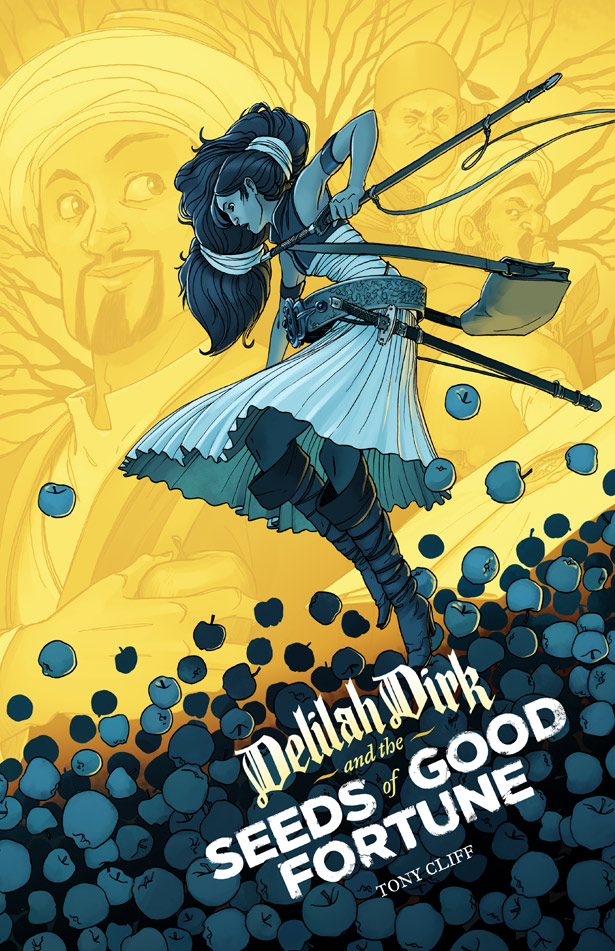
Delilah Dirk: The Seeds of Good Fortune

One of the best webcomics going, Tony Cliff's "Delilah Dirk" is beautiful, with a rich and engaging historical world. The title character is a swashbuckling lady who's not QUITE as smart as she thinks she is, but is lucky enough that she gets away with it.

Cliff's art is simple yet gorgeous, and he fills in beautiful details on every page.

One of the real delights of this little side story is a two-page spread in which Delilah runs away from a passel of bad guys -- Cliff does this out as a single image with a dotted line showing Delilah's path through a tangle of alleys and rooftops. It's like one of those Family Circus panels where the little kid goes wandering around and by following the path you get the story of what happens. It's very cleverly done and perfectly fits the light-hearted feel of the story.

The story itself finds a little more depth than you might expect, for what is basically just an extended chase sequence. It's got a tight structure to it and some good character moments. I'm really looking forward to a print version of the main story before too long.

Lola

J. Torres and Elbert Or teamed up for this spooky-sweet story about a young lad uncomfortable with his heritage and what it means for his day-to-day life. Set at a Philipino family gathering, this book is a perfect balance of art and words; Torres' tight, understated script is brought to perfect life by Or's clean lines and striking compositions.

Anyone who's had to deal with uncomfortable family moments will identify with our young protagonist, who finds his memories of his grandmother and his deceased cousin are still shaping his life years later. Frightened by much of what he can remember, and dismissive of the traditional tales that his Philipino family tell and re-tell, Jesse (our hero) manages to gather his courage and ultimately decide on what his relationship with his own spooky background will be.

Until you get to the end, and the story sticks you with a nasty twist that left me both chuckling and aghast. It DOES say "A Ghost Story" on the front cover, and these gentlemen aren't kidding around about that.

A beautiful book, and a joy to read and re-read.

Bamboo Blade

I was not familiar with the work of Totsuka Masahiro before reading this, which was recommended to me by a friend who knows very well what I like. And teenage girls beating people with sticks is high on my list. I'm certainly looking for more work by this masterful writer.

If you don't think that's funny,
I don't know what you are.
Bamboo Blade is a 14-part manga about a high school girls' kendo team. If you're thinking, "manga about high school girls, uh-oh," rest easy -- this book has nothing in it of a salacious or titillating nature. No panty shots or ridonkulously enormous bosoms. Just charming young folks trying their hardest to do well.

What this book is is really really funny. I mean, hella hilarious. Every volume left me gasping in laughter at some point or other. Totsuka's sense of timing is impeccable, and his characters are so finely delineated, and yet so over-the-top and ridiculous, that hilarity erupts in every situation. And the artist, Aguri Igarashi, supplies those situations with tone and style changes that move so fast you're left scrambling to catch up. Even apparently dramatic moments (don't worry, nobody dies) like the one at left are given a buzz through the ridiculous filter -- the whole book is full of quick tone transitions like this. This stuff, where the style and tone change so dramatically so quickly, gives the book a spontaneous, "anything can happen" feel, and keeps the mood light and frothy throughout.

At the same time, the emotional beats are varied and often mature. The putative protagonist, the kendo club teacher, is a young man whose personal life is a disaster, and his selfish efforts to get out of trouble have a real impact on the students under his charge.

14 volumes is a pretty big investment, but Bamboo Blade is maybe my favourite book of all I read in 2012. The writing and the art are both top-notch, and it's just so damn funny.

Morning Glories

Nick Spencer and Joe Eisma are obviously having a lot of fun with this book, and it's infectious. If you don't know, Morning Glories is a crazy over-the-top "what's going on" story about a high school run by sinister, ruthless administrators who appear willing to murder innocent kids in order to accomplish whatever strange objective they're pursuing.

Weirdness, terror and of course good old-fashioned high school angst all feature prominently. The main characters are the latest group of six kids brought to the school -- they don't know each other, they largely don't like each other, and they soon discover there is no one else they can trust. Although trusting each other proves no less fraught with peril.

Now published in three trade paperbacks, with more story to come, it's easy to get started on this book, and so far it's been plenty of fun.

Ooku

Fumi Yoshinaga's Ooku, now into its seventh volume, is astonishing. An alt-history in which Tokugawa Japan is led by a series of female shoguns, Ooku dissects male-female relationships, assumptions and prejudices, while telling not only a mind-blowing story of an empire based on a massive shortage of males, but truly heart-breaking tales of people caught up in an impersonal system, and how tiny decisions balloon out into disastrous consequences.

The seventh volume came out in 2012, and at this point it appears the flash-back history that has explained how Japan ended up ruled by women and sealed off from the rest of the world has been wrapped up. The current shogun, Yoshimune, has gotten the full story at last. But now she faces a tremendous dilemma; does she perpetuate the system that has brought her to power, or can she find a way to reverse the mysterious ailment that has robbed her nation of most of its men?

Full of sex, torture and sweetly gentle romance, Ooku is a real gem amongst comics nowadays. Smarter than any other book I'm currently reading, and more consistently engrossing.

Easily winning The Most Insane Comic Book Of The Year award, Jeremy Bastian's Cursed Pirate Girl oozes madness from every page.

Lewis Carroll is the only possible comparison, but Bastian's wild baroque art exceeds Tenniel's classic illustrations of Wonderland in detail, bravura and sheer whack-a-doodle craziness. Sword-fighting fish, submersible parrots, giant octopuses, and more pirates than any book really needs fill (and frankly step out beyond) the pages to create a story and a world so overwhelming that the plot hardly matters at all.

Our heroine (she's a girl, cursed, pirate -- you get the picture) is searching for her father, who is (according to her) one of the legendary pirates of the Omertà Seas. With a few loyal companions she takes to the waves to find him, and in doing so runs afoul of monsters above and below the waves. 

There's a map. There's a poster. There's fan art. It's completely insane, and completely brilliant. Read it.

Make Your Own Haters

Not the famous poster,
but has Dejah Thoris.
I really wanted Andrew Stanton's John Carter to be good. And it's pretty good. It's not terrible. It deserved better than it got in the market, I think.

But I can see now what really holds it back from greatness. And it holds a great lesson for any GM (and plenty of other story-tellers, too). It's a lesson I myself have struggled to remember, time and again.

You just don't hate the bad guys enough.

And for a fantasy adventure story you need bad guys you can really hate. And in a fantasy adventure movie, you need to get to the hating right away. Your audience needs to HATE.

That's the lesson: a great fantasy adventure needs massively hatable bad guys.

Villainous Villains

Why is it especially important to get right to the hating in a movie? Because movies are really short, and they operate visually. Every second your audience spends trying to distinguish characters from each other is a second in which you've lost the opportunity to make them care. Important characters must be immediately distinguishable from others. Visually. We have to understand their relationships and our own feelings about them viscerally, not through explanation.

Let's compare the opening of John Carter with a couple of other films that I think are trying to tell similar sorts of stories, and did so magnificently: Star Wars and The Fellowship of the Ring.

Both of these films, like John Carter, start by setting up a large-scale conflict that will draw in our unsuspecting hero. Over the course of the story the heroes will come to take on the conflict as their own, and prove to be essential in its resolution. What's crucial, then, is that the audience care about the conflict. They need to be emotionally invested in the outcome of the conflict. And this has to happen fast, because, as I mentioned, movies are short. When you've only got a couple of hours to build that emotional investment, every moment of confusion or uncertainty in the audience reduces the potential impact of the story.

Done Right

30 seconds in, and you already know
who to cheer for.
The opening shot of Star Wars is rightfully one of the most classic openings in cinema history. Not only is it a fantastic technical achievement, but it tells the story right away. There's these scrappy little guys in some sort of ramshackle arrangement, and they're getting pushed around by these big bullies in this ENORMOUS HELLO I WILL EAT YOU spaceship. You know right away whose side you're on, of course, and that impression gets steadily reinforced as the opening scene plays out: kindly-faced Rebel soldiers looking worried as they get steadily gunned down by visored unstoppable soldiers, and then DARTH VADER appears all in black with a skull mask, and he murders some guy and then intimidates the plucky princess. Later on he will strangle some dude and BLOW UP A PLANET. And THEN he kills Ben. Jeez Louise.

We understand quickly that he's the bad guy, we hate and fear him immediately, and we are repeatedly shown reasons to continue hating and fearing him. We REALLY want Luke to get rid of this guy, even though it seems totally impossible. And we immediately recognize him later on, and we feel that hatred and fear without having to think about it.

One of the best things Peter Jackson ever did was to understand exactly who the bad guy is in The Lord of the Rings, and the opening of Fellowship makes it very clear. The battle between Isildur and Sauron, Isildur's moment of weakness at Mount Doom, and his subsequent betrayal, all of this tells us right from the get-go who the terrible trouble-maker is: the Ring. The Ring is bad, and we know it five minutes into the movie. We've seen it doing bad things, and we fear and hate it for the rest of the film.

Done Wrong

Basically identical to every
other guy in the movie.
So, compare with John Carter. Much like these movies, it opens with a scene depicting the larger struggle: in this case a battle between nearly-identical bands of flying soldiers. The leader of one group of nearly-identical soldiers is nearly identical to all the other soldiers, and appears no more competent or dangerous or hateful than the rest. Sure, he's killing people, but everyone in the frame is killing people, so...

Sab Than inspires neither fear nor hate. He's not doing anything that obviously needs to be stopped, and stopping him doesn't look any harder than stopping another random guy with a sword in a flying airship on Mars.

"But," you say, "Sab Than's not the real bad guy! This story is all about Matai Shang!"

Okay, so Matai Shang shows up, and yep, he's visually distinctive, at least. And he can apparently fly. And he gives Sab Than a big blue glove and says "This is awesome." So Sab Than tries to blow up Matai Shang with it, and nothing happens.

So that's not very impressive. We're still left with no real reason to hate Sab Than or Matai Shang, and Than's foolishness only makes both of them even less fearsome.

And Matai Shang changes appearance constantly through the movie, which undermines the point of his distinctive appearance. The whole point of giving a primary character a distinctive appearance is so that you can steadily build up an emotional association in your audience. When they see him, they see him doing something awful, and they hate him even more than they did before. They build an association between that feeling of disgust and his appearance.

Every time he appears in some other guise, that association is made less intense. So Shang's constant shape-changing undermines what's already a problem about this film -- our lack of emotional investment in the conflict of which he is a part.

And Shang never appears to do anything all that terrible, anyway. Nor does Sab Than. Oh sure, there's killing guys, but war is hell, right? And there's TALK about vague, terrible things, but we don't SEE any terrible things, so we don't develop any association between these characters and a sense of disgust or hatred. They're not blowing up planets and torturing plucky princesses. They're not corrupting brave warriors or whispering to Ringwraiths. They're not doing much of anything, it seems.

The Lesson

I'm not trying to hate on John Carter. I like the movie. Stanton's takes on both Carter and Thoris are fantastic, and both actors do a great job bringing two of my most beloved characters to life. The action scenes are well-played and the Tharks are other beasts are awesome.

But this is an instructive lesson, I think, for storytellers of all stripes, including GMs. It's hard to create truly memorable villains in an RPG, since so many games are crafted around the idea that the players will win every encounter. That means that upon meeting the bad guy, they will defeat him, and so there's rarely much of a chance to really build up that sense of hate and fear.

But how do you introduce bad guys, get your players to hate and fear them, without making it an immediate fight to the death? How do you delay the action of justice so that it's all the more satisfying when it happens?

One of my most memorable bad guys was an accountant. There's something about accountancy that helps keep players civilized, maybe.

I often outright tell my players to not try fighting a bad guy out of their weight class. My reasoning is that the characters are receiving far more non-verbal information than I can give the players, and so they have access to an understanding the players do not. So if I say, "You're very sure this guy will beat you all to a pulp if you look at him sideways," that's just their characters understanding some cues that are hard to express through the sort of narration available to a GM. Once the players are willing to let the scene play out, I find it much easier to build up bad guys they can really hate.

But are there better ways to do this? Do some games handle this better than others?

The Steel Angel

A thousand years ago, rumour spread that the greatest swordsmith in the land had created four perfect blades. Stronger than any other swords, sharp enough to cut through stone, and as beautiful as the sky at noon.

The rumour said he'd named the blades the Four Steel Demons.

Rumour reached a gang of heartless bandits, who rode that very night to the swordsmith's home and demanded he give them the swords. He refused, and they cut him down and took the Four Demons for themselves. They butchered his family and burned the entire town to ashes.

In the years that followed, made unstoppable by these peerless blades, the bandits unleashed hell on earth, cutting down all who stood in their path. They revelled in slaughter and nightmare, and the land itself ran with blood. Only once they fell to fighting amongst each other did the reign of terror finally end. All who'd heard the rumour cursed the smith who'd made those blades.

But the rumour had been untrue. The smith had not made four perfect blades.

He'd made five.

This is the story of the fifth sword, the only weapon that could stand against the Four Demons...

THE STEEL ANGEL


And now, a thousand years later, the Four Demons are stirring once more. Only the Steel Angel can stop them -- if a hand can be found to wield it.


Great, because what I need right now is ANOTHER idea.


Image by Deoris

An Unexpected Trove

Since coming to Toronto, I had heard rumours that the Royal Ontario Museum held an exceptional array of Japanese swords in its archives, unavailable to the public. Finding a way to get a look at those swords has been on my mind for years now, but thanks to some very well-connected friends, Toronto Kenjutsu was privileged to go behind the scenes at the ROM and examine some of its many treasures.

The rumours were well-founded. We stood around in stunned amazement as tray after tray of fabulous works of art were presented to us. Swords of the like I never thought I'd get a chance to look at, much less handle (after very stern lessons on proper handling of priceless artifacts), lay before us in stacked rows. It was truly an amazing experience.

One day was not sufficient to go through all the treasures, but we found plenty to marvel at. There were gorgeously detailed koshirae, classic katana and a number of very strange swords, difficult to classify but fascinating to consider and wonder about. We passed them around, our hands encased in thin gloves to shield the ancient artifacts from our skin and its oils. There were swords that had been made for battle, and many bearing signs of heavy use (though whether on the battlefield or just getting thrown around by an incautious owner, it's hard to say), and then there were some in breathtakingly perfect condition. And not only swords; we examined daggers and spearheads and other edged weapons.

While not everyone finds the Japanese sword AS compelling an object as most of us do, there's no denying the elegance and beauty of these artifacts, and the careful detail that goes into them.

This little moth pattern appeared on a kurigata -- the little knob on the sheath to which the cord is attached. It's no wider than your little finger, and yet so much care was lavished on it. We saw item after item like this, until the mind could scarcely take it all in.

But this attitude, of attaching importance even to the smallest of details, is paramount in our practice. The angle of the feet, the line of the cut -- if these are not understood and performed to the most exacting standards, the sword will not cut. More importantly, if the mind is not fully present, and not truly aware of all these tiny details, then opportunities slip away, and vulnerabilities are not seen or attended to.

It's not that there is only one 'correct', or 'perfect' way to perform the kata. But as I practice, as I strive to attend to every conceivable detail (and Sensei is always able to find yet another detail I am not attending to), I learn to open my mind to what is truly in front of me. To let go of my preconceptions and prejudices and see clearly that which is actually there.

This last illustration came from a massive sheath -- carved from a single piece of ivory that can only have come from an elephant's tusk. It was covered all over with carvings of this sort of detail and delight. Full of samurai pursuing each other, swinging swords and naginata, on horseback or on foot, beautiful images of fighting men in poses and stances that we practice to this very day.

We will never use our arts for the same purpose they did. We will never kill or face death at the end of a sword. But the wisdom those long-ago men learned in that violent, terrifying fashion still serves us today.

We are very grateful to the staff members at the ROM for accommodating us and making this visit possible. It was honestly a dream come true for all of us, and we will always remember that day.

Forging Imperfection

Is there a perfect blade? A perfect cut?

If there is, I'm not sure I've ever seen one, or at least, I've never recognized it as such. That may say more about my powers of observation than anything else, but while I've been astonished at the beauty of some blades, and some cuts, it wasn't perfection I was seeing. Any piece of steel forged by hand will have irregularities in it. Connoisseurs of Japanese blades seek out irregularities and celebrate them. Smiths strive to produce just the right irregularities in just the right places, to elevate the steel, to display its natural character or to create a specific effect in the viewer.

A beautiful blade is not perfect. My sword, pictured here, is hardly perfect. The afore-mentioned connoisseurs will probably point out that it's not particularly beautiful, either, but never mind them. But I do love my sword, and I have grown to appreciate the beauty it has more and more over the years.

When I watch Sugino Sensei perform the kata of Katori Shinto Ryu, I don't see perfection. I couldn't possibly imagine how it could be improved, but I can see that his version of the kata is different from his father's. It's different from Ishida Sensei's, or Iwata Sensei's. It's of course different from Otake Sensei's as well. All the great masters that I have had the privilege of observing have performed the kata differently.

Those differences appear to me now like the grain in the steel of my sword. Subtle (or not so subtle) variations, all of which work together to make the steel strong and beautiful. If the steel had no grain or flow to it, it would be mechanical and lifeless, but Katori flows through its students, moving onwards from one to the next, and nobody does it 'perfectly'. Everybody's version is irregular somehow.

Through practice, those irregularities can be constrained, or directed, but if they can be eradicated, well, it doesn't seem to be happening in my case. But just as a great swordsmith brings out the natural, inherent character of the steel when forging a sword, perhaps steady practice in Katori can do something with my own natural, inherent character.

Princess PUNCH!


This is such a great example of what I love about the Internet, I just had to post it.

If you've seen the trailer for Zack Snyder's upcoming film Sucker Punch, this mash-up will blow your mind.

Breanne Brennan has been making her own trailers from her favourite films for years now, which explains how she was able to put this together. I wouldn't even know where to start, even if I was brilliant enough to have the idea in the first place. I don't know how she finds the lip-synched moments, but some in this mash-up are just uncanny.

But what I think this really proves is the profound depth and quality of classic Disney animation. These brief shots are all (or at least mostly) so full of character and story that they make this admittedly silly exercise work. Close-ups of Cinderella and Aurora carry actual emotion, and draw you in even without the context of the film they come from. It's really a testament to how amazing that studio was.

The loss of 2-D hand-drawn animation is a loss to cinema. While I love the work of studios like Pixar, I'm glad that Miyazaki at least is still carrying on with beautiful cel work, but it's too bad the Disney studio can't find a way to carry it on as well.

Snyder's film may turn out to be full of awesome, or it may be overblown exploitationist crap. He's a talented film-maker, but I haven't outright loved anything he's done so far. But Princess Punch? I'd totally go see that movie.

Trapped By Honour: 13 Assassins

Japan has since at least the days of Akira Kurosawa's great run of motion pictures in the 50's and 60's specialized in gruesome, grueling combat, often performed by mud-covered, extremely weary-looking actors. From Inagaki's "Miyamoto Musashi pictures through Sword of Doom and on into more recent fare like Ryuhei Kitamura's Versus, Japanese action scenes have almost always been enacted by performers seemingly on the edge of panic and utter collapse.

Even Sonny Chiba looks pretty tired at the end of Karate Bearfighter, but (and I don't think this is too big a spoiler) he did just fight a BEAR.

Takashi Miike is hardly a typical anything, not even a typical Japanese film director (a notoriously iconoclastic breed). His films have ranged from completely insane to mostly insane, to pretty cool but with some completely insane parts. Sukiyaki Western Django was lots of fun but not very satisfying -- which is how I would characterize most of his work that I've seen. Fascinating stuff here and there, but at the end of the film I was kind of left feeling like it hadn't all come together as well as it could. Which, given that he makes four or five films A YEAR, is perhaps not very surprising. But still.

But when I first heard about 13 Assassins, his latest movie, something told me that this time, Miike was going to pull it all together.

I'm here to tell you: he did.

13 Assassins is magnificent. Bloody, gruesome, grueling, and wallowing in muck, the titular samurai take their declarations of honour with them into certain death and defeat. It's a hell of an achievement to have 13 main characters and keep them all distinct in your audience's mind, but Miike pulls it off. Each character serves a purpose in the story; each delivers a different beat, a different tenor to the impact of the film.

Maybe Miike needed to stop trying to be different -- this is as classically Japanese a film as can be imagined. In many ways, it's a remake of Seven Samurai (technically, it's a remake of an older film called 13 Assassins, but bear with me). There's the pulling together of the team, the preparation for the battle, and then the final overwhelming sequences of nightmarish brutality. But where Kurosawa's film takes great pains to situate the story and the characters in the larger world, Miike pushes all that aside. The villagers are represented in a mere cartoon of a headman, and have nothing to do with the story at all, and rather than outline for us very carefully the layout of the village where the final confrontation will take place, Miike hurls us headlong into a bewildering maze of narrow streets, collapsing buildings and transforming gates. The unfamiliar town traps all who enter it.

As Miike's characters are trapped by honour. Kurosawa's samurai agree to their adventure with eager hearts, and their mission is ultimately a positive one: to protect a peaceful village (well, relatively peaceful). Miike's samurai have their backs to the wall. Some desire revenge, others are motivated by a need to stamp out evil, but none of them are going on an adventure, and none of them have any way out. Koji Yakusho's Shinzaemon, the leader of the band, only perks up at the promise of death. It is that promise that excites him, bored as he is with a life of peace. A valiant death in a lost cause is exactly what he seeks.

Takashi Shimura's Kanbei accepts the likelihood of death, but his embrace of the villagers cause is an honest one: he believes all the way through that victory is possible. Shinzaemon doesn't care -- he only wants to stand in battle and test himself.

And at the end of each film, the lesson is different: the survivors of Seven Samurai accept that they have done what was needed, and they must move on. They can take pride in their accomplishment, but they expect no reward. They will not change and they do not complain at their situation. Whereas the final conversation in 13 Assassins is a loud repudiation of courage and honour -- the catastrophe that has just taken place has drained our characters of moral strength.

Miike's films have always walked an uneasy path through morality, always flirting with nihilism but never quite giving up. It's the same here -- despite the rant against the difficult and thankless path of honour, it's not clear that the sacrifices made in this film are to be viewed as pointless. But at the same time, it's not clear that they are selfless: as I mentioned, Shinzaemon is actively seeking his own death -- his motive for all this is purely selfish, only cloaked under a mantle of honour. He wants a great death; and while there are a vast number of deaths in this film, I'm not sure any of them can be called great.

But they are certainly gruesome and grueling, in that manner that so many great Japanese action films have been. It just has to be said: nobody can flail around in the mud like a Japanese actor.

See 13 Assassins. It is masterful, loads of fun, and subtle, despite the tremendous amount of bloodshed.

Sun, Not Rising

Great science fiction asks us to think about the very concept of being human, of the human experience. Arthur C. Clarke, Isaac Asimov, and Robert Heinlein all took their readers on investigations of what being human really meant, by asking unsettling questions of the type "What if (insert basic assumption about life here) were no longer true?" Asimov's Robot stories ask us to consider if our biology is central to our humanity. Clarke's amazing Childhood's End challenges us to imagine a humanity no longer limited by our need to live on this planet.

Karl Schroeder's remarkable "Virga" novels are asking some very unsettling questions, and providing very few settly-type answers.

His latest book, The Sunless Countries, his fourth set in the bizarre landscape of Virga, pretty much asks the question, "What if animals could use physics simulators? What if a dog or a wildebeest could provide itself with artificial augmentations? What the heck would THAT look like?"

Which is just a pretty nutty question to even ASK in the first place. I mean, what?

So there's characters appearing in this story who can talk, who can make use of completely over-the-top technology, but who aren't sentient. It's a bizarre conceit, made possible only by Schroeder's vision of where technology is leading us: towards the capacity to perfectly model natural processes. When this capacity is trivial to provide, argues Schroeder, we no longer need reasoning to provide us with advancements -- we can simply model natural selection, accelerate it even, and the improvements we desire will be made apparent to us. Once this technology becomes all-pervasive, then any entity capable of desire becomes capable of transforming itself, of developing whole new forms of technological marvels. Entities do not need to realise this is what they're doing. They don't need to possess awareness, just desire. Just hunger. Science itself becomes obsolete when the model's predictive power is faster, more reliable and more available to all.

(that'll really piss off Glenn -- I hope he reads this)

Except of course that reasoning, coupled with imagination (and perhaps given structure via constraints) can always envision solutions BEYOND what the model is capable of predicting, of making leaps the model cannot make. And it's becoming clear that the story of Virga is the story of the last enclave of life that is directed by scientific reasoning and human imagination. Everywhere else, we are learning, has been overtaken by this "artificial nature" that provides everything to everyone according to their desires. Only in Virga do people still puzzle out solutions to their problems. And because of this, Virga is both desired and suspected. How this will all play out is yet to be learned, but Schroeder is telling a fast, compelling story that only reveals its secrets in small doses. Just enough to keep you dying for more.

Perhaps Schroeder is preparing an elegy for science, or a last desperate plea for a beleaguered mode of thought. It's been forty years since the Moon missions. Creationism gets argued for in international media. And science fiction has been struggling without a great visionary voice for decades.

Now it seems we have writers like Charles Stross and Cory Doctorow championing a new, positive vision of the world ahead, something at last tearing down the cyberpunk dystopia that overtook everything in the 80's and erecting in its place a bizarre new world, crazier than the craziest Amazing Stories cover from the days of Hugo Gernsback. Karl Schroeder is staking out bold new territory in this space with giant bubbles of wine, flying icebergs and balloons orbiting distant stars.

And a creepy yet compelling discussion of what "human" means -- even more, what does "sentience" mean and why should we worry about it?

Okay, So I'm Not Crazy

This writer for Xark is contemplating opening up the setting of his unpublished novel. (thanks to @profpope for the link)

He's largely talking about doing what I'm planning with DINO-PIRATES OF NINJA ISLAND, only around a novel rather than a game. The idea of setting up a foundation to support the open setting is interesting, though, along with the proposed requirement that folks who make money off the setting be required to contribute some portion of that money to support it.

It's an idea.

Copyright is getting munged in all sorts of ways. As maybe some of you know, I'm in favour of lighter, leaner definitions of copyright and what it protects or doesn't protect. I got into a discussion with Ed the Sock a couple of months back about use of one's intellectual property. Ed's point was that if folks get to re-use your work, they can make it look like you said something you didn't. I argued that this isn't a copyright issue, it's a slander/libel issue. I remember when Raincoast Press used copyright to silence people who had received the new Harry Potter book early (because of Raincoast's error) -- as though the right to control the copying and distribution of a work granted the right to muzzle people who have received it legally!

Of course, I've probably mis-represented Ed's views here and will get a copyright lawsuit slapped on me. Great.

Anyway, my point with Ed (and I failed to convince him, and he's pretty smart, so keep that in mind) was that copyright is best handled as a purely economic law -- controlling the right to profit from distribution of an artistic work. Not a generalized control over the work and its presentation.

Well, so anyway, the idea with DINO-PIRATES is that the creation of the setting is open to all, and anyone who cares to can profit from the setting if they can come up with a marketable product based on it. It would please me immensely if somebody got rich off this. I ain't greedy that way.

In other news, some really dedicated fellow (Christopher was his name) sent me a whole list of dead links on the DINO-PIRATES OF NINJA ISLAND site but email server hijinks deleted his emails. Christopher, if you're reading this, can you send those again? Or at least know I really appreciated your efforts...

If We Can't Pin Down the Medium, What Happens to the Message?

So the story of how DINO-PIRATES OF NINJA ISLAND came about is interesting enough, but the story of where it's going is starting to get even more interesting.

The whole thing started when super-genius JPL commented that he'd missed out on a competition for the best fantasy setting. In his words, his entry would have been:

fantasy Asia, filled with warring island nations. Samurai mounted on domesticated raptors. Bigger dinosaurs hunted by quasi-Polynesian tribesmen. Dueling factions of shadow warriors. Privateers and bucaneers battling the servants of the Imperial Navy. Fallen kingdoms deep in forgotten jungles. And I call it...

DINOPIRATES OF NINJA ISLAND!


Thus was born the legend, which turned into a couple of sprawling discussion threads and eventually culminated in me writing and running the adventure SLAVE QUEEN OF THE RUINED CITY, the first official DINO-PIRATES adventure. There was a short-lived campaign as well, and an online play-by-post game, but the DINO-PIRATES setting is starting to find a little traction in places outside the curious world of pen and paper role-playing games.

Battleships, Communists and Demons

We went to see the classic Eisenstein film Battleship Potemkin last week at the Cinematheque.

We'd seen it a couple of times on video, as much out of a sense of duty as anything. I mean, you HAVE to watch Potemkin. You HAVE to. What are you going to do when you're talking to REAL cinema fans and they start talking about it? Fake it? Come on. You HAVE to watch Potemkin.

Anyway, seeing it on video is woefully inadequate preparation for seeing it on the big screen. It was a SHATTERING experience. One of the most exciting films ever made, still. Ranks up there with King Kong. Bad-ass.

I defy anyone to watch that film in the theatre and NOT come away going, "I wish I could join the Communist Revolution and take back power from the capitalist overlords!" It's such an emotional argument -- it's impossible to debate Eisenstein's overwhelming enthusiasm for the revolution and all it means to the downtrodden and hopeless. But at the same time, it was interesting to note for the first time how the enemy of the revolution gets steadily less and less "faceful" as the story moves onwards and outwards.

When it's just the sailors on the battleship mutinying, the bad guys are clearly outlined for us: the arrogant captain, the sneering ship's doctor. We see them clearly and their downfall is a triumphant moment. The next round of villains (aside from the sneering facist whose calls for racial cleansing are spurned by the fair-minded brothers and sisters of the revolution) are the Cossack soldiers, marching in line down the steps, their uniforms identical, their steps perfectly cadenced, their faces never shown. They are the mass -- the undifferentiated human product of capitalist society, put to mechanical work serving their masters at the expense of the proletariat. Who are NOT undifferentiated but made up of one individual after another, Eisenstein is very clear about that.

The Cossacks are much less individual than the ship's officers were. And the final villains of the piece are even more so -- they're never even shown at all. The crews of the oncoming squadron are never on screen. All we see are the ships pumping smoke and churning up the sea, until at last the triumphant conclusion overwhelms all else and the proletariat revolution takes over the globe.

Which is I think the problem -- Battleship Potemkin is an illustration of the Communist religion dealing with the question of evil. If the revolution is inevitable everywhere, and if everyone will eventually see the truth and light of the socialist way, then nobody's really AGAINST us, are they? I mean, IF we're right, then ultimately EVERYBODY is on OUR side, so who are we supposed to fight? As the scope of Eisenstein's revolution expands, his villains MUST get more and more indistinct, less and less human. Because it's very difficult to justify running around killing other humans if they're really going to be on your side in the end.

Which now brings us to demons and the problem they present.

Basically, demons are a convenient tool for telling stories, because you can have your heroes slaughter them remorselessly for hours on end if necessary. Nobody has to feel bad, cause they're demons. They're inherently EVIL. They DESERVE to die.

Ah. Deserve.

But in the end, what does "inherently evil" even mean? Does it mean they just do cruel things all the time, like torture puppies or talk in movie theatres? Are EVIL creatures just big meanies?

Well, it has to be more than that. Cause it's not okay to run around killing people just because they're mean. So maybe "inherently evil" means "incapable of good". Okay, so whenever given a choice, a demon does the evil thing. Which gets retarded almost immediately -- whenever somebody's talking to the demon, the demon punches them in the face. Or stabs them. This must make demon-to-demon communication kinda hard. But if the demon sits and listens politely, even if he's planning to do something really horrible later on, he's still doing something NOT evil right now. If he happened to fall off a cliff before his evil plan came together, the person he was talking to would think, "Gosh, that demon sure was a nice fellow. I'm going to be nice to kittens from now on." and suddenly the world is a better place because that demon was in it. Which means that running around killing demons "just because" actually might be a bad thing, because the demon might inadvertently be just about to do something good just when you kill him, and thus your killing him is an evil act.

Whoops!

Eisenstein gets around the Demon Problem in the time-honoured fashion of dehumanizing his revolution's enemies. Many fantasy authors and game settings take a half-baked philosophical approach and pretend you can coherently imagine creatures of pure moral constancy. I prefer my demons to just be people. People who maybe aren't very nice, maybe aren't very concerned with other people, but who are people acting for people-like reasons. It may be less exciting, but well, it may not be.

Thoughts on Communism, revolutions, demons, and cinema? When designing a setting either for a game or a story, what sorts of choices this way do you lean towards?

The Self, Extended

Being a DM is a pretty strange activity most of the time, but there are times when the strangeness intensifies even beyond what seems "normal" for an activity that largely involves making up imaginary stuff so that imaginary people can pretend to interact with it. And doing a fair amount of probabilistic math.

Sometimes the imaginary stuff you (or at any rate, I, and if I'm going to go through this, why shouldn't you?) come up with seems to be generated less by a process of making stuff up and more by a process of discovery, as though the stuff had existed all along, and it only took you opening up the right door or turning on the right light switch to find it. Artists of all sorts have talked about this experience -- Alexandre Dumas famously wept as he wrote one of his beloved character's death scenes (no, I won't tell you which one. Read his damn books!), and Robert E. Howard wrote repeatedly of how Conan simply appeared, fully-formed, and in a sense dictated his adventures to Howard for the Texan to write.

The characters we create are inventions; they don't exist in the meaningful way that I (the guy typing these words) or you (the person reading them) do. Obviously. And yet, that doesn't mean they don't exist AT ALL. That doesn't mean they aren't REAL in some sense.

Anyone who cried at the end of Old Yeller proves that characters have a real existence and influence on the world. Even if that's only in our imagination.

Our imagination is what gives fictional characters their power of us. It's also where they come from. And while we may like to think that we actively "make up" things, the truth is far more complicated than that. Our imagination, after all, makes US up, too. Our whole identity is constructed by our imagination out of the endless stream of sensory input our brains manage. So if our imagination invents us, who invents our imaginations?

My Barsoom campaign was a sprawling unwieldy tale (as are most lengthy campaigns) that lasted over five years and went through more twists and turns than I can readily relate (or recall, to tell the truth). Many and varied were the characters that emerged from that lovely mess, and many of the folks I invented over the course of the tale stick with me still, easily remembered even though many of the details of who did what to whom have fallen by the wayside.

Exasperated Kimiko Torokan, trying to do the right thing but feeling more and more trapped between equally evil alternatives. Arrogant and cruel Matai Shang (see? Barsoom!). Affable Phelan. Angry and suffering Zuleika.

It's a strange business, as I say, this DMing gig, and it never gets more strange than in the delicate balancing act required to create (or discover) compelling characters and yet keep the story's focus squarely on the PCs. As a DM, your characters have to be supporting roles, and yet, for them to be compelling and engaging for your players, they have to be complete, with stories of their own that you need to be invested in.

But not too invested. The trouble comes in that of course, the characters you discover (or create) come out of youself, and so reflect truths about you. There's no avoiding that, and it can get downright uncomfortable to realise it, especially when you look back over some of the characters you've created. Or discovered.

You can read too much into that, of course, but the truth is this question of creating or discovering is kind of at the heart not only of the DMing process, not only of the artistic process, but of the process of self-discovery.

Or self-creation.

We're all story-tellers, no matter how inarticulate we may be. Human beings are story-telling creatures and we understand the world and ourselves primarily through the stories we tell. We know ourselves as the stories we tell about ourselves, and those stories are both discovered and created as we go through our lives. We recognize a trend in our behaviour, or we invent one; it's all the same. It all becomes part of the story of who we are.

Artistic creation, and for a DM, the creation of characters, is part of this circular process, both creating newness and discovering what was already there. My characters, the great ones that is, the ones who seemed to have ALWAYS been there, and who even now must be carrying on with their imaginary lives, those characters both revealed truths about me to myself, and allowed me to create truths about myself. The legendary beauty Yuek Man Chong, born of a margin note scribbled without thought, nearly took over my campaign, had to be destroyed, and yet filled up pages of notes and thoughts and speculation. I don't recall ever inventing anything about her -- it was always as though I was learning more and more about who she was, who she had been and who she might yet become. She was bigger than me, as strange as that seems to say. But the process of discovering her was really a process of discovering me, and realising that I, too, am bigger than myself, because I always hold the ability to go beyond what I am now, what I understand myself to be.

When I make up imaginary people, I'm really creating new possibilities for myself, or discovering new terrain within the familiar landscape of myself. Which is a pretty cool thing to do while pretending to kill orcs.

Picture by James Ryman

Japanese Horror: The Transmission of Suffering

The great explosion in a genre that can only be called "Japanese Horror" began back in 1998 with the little film called The Ring, by Hideo Nakata. And a little girl crawling up out of a well, and occasionally out of other things little girls have no business crawling out of.

Recently I watched one of the more unlikely follow-ups to Nakata's enormously successful film, Hair Extensions. Yes, this film is in fact about murderous fashion accessories. It's creepier than you might think, and a great performance from Chiaki Kuriyama gives it a weight it wouldn't otherwise earn. But it got me thinking about the phenomenon of Japanese Horror, and in particular how these films differ from, say, western horror films.

Now, in any successful horror film, it is clear to the audience that by the end of the film, judgement has been handed out. Those who died horribly may not have "deserved to die" in any realistic fashion, but the audience understands that they broke the rules and they must pay the price. This is a basic truth of all horror films -- they are reactionary, extremely conservative stories in which even the slightest mis-step is punished with torture and horrible death.

But in the western mode, the punishment comes typically at the hands of one who was wronged, with no mediation. Jason, the killer of the Friday the 13th films, was drowned in a lake as a child. The endless cycle of murders he perpetuates are his rightful claim to justice. But the killing is done by he himself.

In the Japanese tale, punishment is mediated by others. The Ring videotape is passed on from one viewer to the next. Evil extensions are placed in the hair of unsuspecting salon customers. The suffering of one is distributed throughout society. In a film like Kiyoshi Kurosawa's Pulse, the suffering virtually destroys civilization entirely.

In Friday the 13th, those who commit wrongs are punished, but society itself is not implicated. In films like The Ring, all of society is made guilty for the suffering of one. The dreadful suffering of one little girl is EVERYONE'S responsibility. She has the right, says this film, to take her vengeance on any of us. We allowed this to happen; we must bear the punishment.

You can see it as a continuation of the theme of a film as old and tired as Godzilla -- all acts are social acts, and so we cannot dodge our responsibility for being part of the society that allows terrible things to happen.

A film like Hair Extensions is probably a sign that the "Japanese Horror" genre is overworked. None of the follow-ups to The Ring have lived up to that film's searing moments of terror. It will be interesting to see where the next great wave comes from.

march


So spring has come,
Oh Jesus,
not again.
The cold has sunk too deep; too frozen now
the furrows of my heart; for any plow
would splinter here;
this chill-swept, dark terrain.
No, not for me;
this year, let me abstain.
Let wither further, wither all, allow
cold, stiff corrosion to gnaw at every vow.
Numb every oath, let nothing pure remain.
The only purity
is purity of ice,
for spring's encroachment on the land
brings but a new,
capricious tyranny.
Each year this joke gets harder to withstand:
that leaves sprout new, that swallows come on wing,
that mourners laugh, that winter
melts to
spring.

I still think this is the best thing I've ever written. Originally published in the Filling station calendar way back in, uh, '96 or so, I think. There is one defective line metrically (though I think it's a defensible variation) in the poem: a year's subscription FOR FREE to anyone who can point it out.

Photo by He and Fi.

Parental Guidance Suggested

This was inspired by an overheard exchange. I'm not usually one for large amounts of profanity, but this really fucking amuses me:


The Sopranos Meet Abbot and Costello


A: They give ball players some funny fucking names these days.

B: All right, fucking wise guy, tell me about the fucking team.

A: Well, we got Who on Fucking first, What the Fuck's on the second and Fuck You on third...

B: You don't know their fucking names?

A: Fucking right I do.

B: All right, who's on fucking first?

A: Fucking right.

B: I mean the fucker's name.

A: Who.

B: The fucker on first.

A: Who.

B: The first fucking baseman.

A: Who is on fucking first!

B: I'm fucking asking you who's on fucking first.

A: That's the motherfucker's name.

B: That's who's fucking name?

A: Fucking right.

B: Fucking tell me.

A: That's fucking it.

B: That's who?

A: Fucking right.

PAUSE

B: Look, you gotta a fucking first baseman?

A: Of course we fucking do.

B: So who's playing fucking first?

A: Fucking right.

B: When you pay the fucking first baseman every fucking month, who gets the fucking money?

A: Every fucking dollar.

B: All I want to fucking know is the name of the fucker on first fucking base.

A: Who.

B: The fucker that--

A: That's fucking it.

B: Who gets the fucking money?

A: Well, sometimes his bitch rolls down and collects it.

B: Whose bitch?

A: Fucking right.

PAUSE

B: All I'm trying to find out is what the fuck's the guy's name on first fucking base.

A: No. What the fuck's the guy's name on second fucking base.

B: I'm not asking you who's on fucking second.

A: Who's on fucking first.

B: One fucking base at a time!

A: Fuck. Take it easy.

B: I'm just fucking asking, who's the guy on fucking first?

A: Fucking right.

B: Ok.

A: All right.

PAUSE

B: What the fuck's the guy's name on first base?

A: No. What the fuck's on second.

B: I'm not fucking asking you who's on fucking second.

A: Who's on fucking first.

B: Fuck you.

A: He's on fucking third, we're not fucking talking about him.

Respond With Life!

After practice tonight I was polishing my sword (no, that's not a euphemism (and yes, I can hear you snickering back there, Joshua)) and D mentioned that while she feels like she's able to do the stances when we're just practicing the stances, she has a hard time recognizing them in the katas.

And I missed out on the classic "Horrible Things Great Teachers Say" moment -- I totally FAILED to say, "Don't worry, you aren't doing them right in practice, either." Damn. That would have been pretty funny.

What I DID say was something or other about how they're supposed to be different, because the kata aren't just there to link together each stance in a particular order so that you can pretend you're swordfighting. The kata are living, breathing intellectual artifacts that only exist because people embrace them, possess them and then pass them on to others.

I said, "It's a practice, not a formula."

So I was riding the Ossington bus back down to King Street and listening to the Propellerheads' version of "On Her Majesty's Secret Service" (which if you don't know is MIND-BLOWING) and thinking about D's question and how that principle of practice over formula really applied at every level of Katori practice.

When I am going through the kata with my partner, I cannot just "do the moves". The "right" stance will be fatally wrong if my partner is doing something other than what I expect. Katori asks you to pay attention with your WHOLE self to your partner, and to adapt your body, your posture, your soul, to what they bring.

To respond with attention and focus and vitality. With life. Respond with life.

And I thought, as John Barry's fantastic horns rose up around me, as the bus turned onto Strachan Avenue, that "Respond With Life" was just a great... I don't know. Thing. Saying. Stance.

Hey, yeah. Stance. The "right" stance in Katori, always, is to Respond With Life. SEE what's really there, shed your expectations and see through to the heart of things, and then see into yourself and find exactly the position, the posture, the STANCE that will make the most of it. That will be alive and vital and strong and courageous.

Respond With Life. It's a stance.

Photo by Arty Smokes

Sword and Foot

"Sword and foot!" is one of those phrases I associate with my time at Sugino Dojo; I can clearly recall Sugino Sensei roaring that at me again and again: "Sword and foot! Sword and foot!"

He was reminding me of a basic tenet of Katori Shinto Ryu: that the sword must act in concert with the body. When the sword starts moving, the foot starts moving. When the sword stops, the foot stops. Sword and foot.

This principle is evident in the most basic fundamental of Katori Shinto Ryu, the straight head cut called maku-uchi men. As the sword rises up, the front foot draws back until, when the sword reaches it apex over our heads, the front foot reaches the rear foot and we are standing with our feet together. And so as the strike comes down; the sword begins its descent and the front foot slides forward, so that at the moment the sword completes its movement, the foot has returned to its original spot and we are once again standing at the ready.

It sometimes seems like an impossibly difficult thing to manage, to cause an external object to move in perfect timing with our own body. I joke that I have never performed maku-uchi correctly, but it's not exactly a joke. Getting the sword and the foot to move in perfect synchronization challenges my awareness and my coordination.

Hence Sensei's constant admonishment: "Sword and foot!"

But learning to work in concert with the world around me has been a fundamental lesson, and it seems that the better I get at making that sword move in time with myself, the better I get and doing the same with other, more abstract features of the world.

It's not just a case of imposing my will on the world around me. That can get me to MOVE the sword, but in order to operate synchronously with it, I need to move myself in accordance with the laws of physics that govern the movement of a piece of steel. I need to enter into a more complex relationship with the sword, one that accepts and embraces its needs as well as my own.

I find the lesson over and over again in my life. Repeatedly I learn to forgo simply directing, or commanding, and to embrace connecting and joining.

Interdependence, not independence.

Especially when dealing with things considerably more complex and unpredictable than swords. Like, say, software developers. I find it very difficult to get software developers to do exactly what I want them to do. Which is probably a good thing, since I'm particularly ill-suited to telling them what to do, not really being much of a software developer myself. Doing my job properly (and by the way, I have a new job; more later) involves very little directing and a great deal of harmonizing. Connecting.

It's kind of hard to describe. Sort of like maku-uchi. I can show you how it's done (sort of), and I practice it a lot, but descriptions never really manage to get the idea across. Likewise managing teams. It's all sort of mysterious and beyond the ability of rationality to encompass. These are things that cannot (and perhaps should not) be put into words, but that can only be embodied in practice.

"Tao" character from Zen Sekai

Robert Lynn Asprin: 1946-2008

Wow, the past few months have been alarmingly full of significant losses. I guess I'm getting to the age where the folks who were my heroes in my youth are hitting that black wall at the end of the race.

Man, I'm so not prepared for Bobby Orr passing on. There'd better be angels and trumpets, is all I can say.

But today it's Robert Asprin, at 62, the creator of the Thieves' World books (which laid the foundation for the Bordertown books which I know you've never heard of, maybe I need to do another in my "Ones Nobody Knows" series) and the writer of the Myth Adventures books, both of which started off so well I can't help but be indulgent towards how they ended up.

Mr. Asprin was able to communicate a love of the absurd, the zany, and the unrepentantly sentimental. The first couple of Thieves' World books contained some great stories, and the whole idea of a "shared world" anthology was part of the cultural shift that Gary Gygax also contributed to.

In the 80's, fantasy culture began embracing the ideas of world-building, ideas that perhaps had been first developed by early pulp writers like Howard and Lovecraft (working as they did upon speculative writers like Verne and even More), and then suddenly Tolkien put a level of detail into it that went beyond what anyone had seen. Gygax and his cohorts, not content with just doing their own world-building, turned that activity into something with social worth -- if you were willing to put some effort into it, and had the requisite skills, you could gather a social group ("Demented and sad, but social,") and work together to generate stories in that world.

Authors continued to work in that style, and Asprin had the genius idea to bring together a number of well-known (and not so much) authors in a single setting. I remember reading his foreword (or possibly somebody else's, talking about him) to the original volume, and how at first the idea was to bring all the famous characters of fantasy together -- so that you could have Conan confront Elric, or Fafhrd and the Grey Mouser slit purses in Minas Tirith. But that turned out to be impossible -- probably my first encounter with the idea of "Intellectual Property" -- and so a new world and new characters were created.

It was a grand vision. It was a Good Thing To Do. The Sanctuary stories were part of the "gritty" trend in fantasy writing -- more Leiber than Tolkien, and better suited to short stories than to novels.

Sanctuary gave rise to numerous other shared projects, none of which ever carried the same cachet as the original. But the idea has stuck around, and moved into different media, and even for myself, has influenced much of what I think about IP ownership and creativity.

DINO-PIRATES OF NINJA ISLAND is going to be a shared setting. It will be open for folks to contribute to, and to take from. I'm still working on how exactly the presentation will happen, but when it rolls out, I think it will be quite unlike any fantasy setting ever seen before -- at least in terms of HOW it gets created and fleshed out. It will be an exciting project, and given that I've spent several years of my life just getting it this far, I think it's fair to say that Mr. Asprin has had an immense impact on my life.

Thank you for Sanctuary, for Skeeve and Aahz, and for the lofty idea that creativity is better when it's shared. I believe you were right.