Showing posts with label film. Show all posts

Make Your Own Haters

Not the famous poster,
but has Dejah Thoris.
I really wanted Andrew Stanton's John Carter to be good. And it's pretty good. It's not terrible. It deserved better than it got in the market, I think.

But I can see now what really holds it back from greatness. And it holds a great lesson for any GM (and plenty of other story-tellers, too). It's a lesson I myself have struggled to remember, time and again.

You just don't hate the bad guys enough.

And for a fantasy adventure story you need bad guys you can really hate. And in a fantasy adventure movie, you need to get to the hating right away. Your audience needs to HATE.

That's the lesson: a great fantasy adventure needs massively hatable bad guys.

Villainous Villains

Why is it especially important to get right to the hating in a movie? Because movies are really short, and they operate visually. Every second your audience spends trying to distinguish characters from each other is a second in which you've lost the opportunity to make them care. Important characters must be immediately distinguishable from others. Visually. We have to understand their relationships and our own feelings about them viscerally, not through explanation.

Let's compare the opening of John Carter with a couple of other films that I think are trying to tell similar sorts of stories, and did so magnificently: Star Wars and The Fellowship of the Ring.

Both of these films, like John Carter, start by setting up a large-scale conflict that will draw in our unsuspecting hero. Over the course of the story the heroes will come to take on the conflict as their own, and prove to be essential in its resolution. What's crucial, then, is that the audience care about the conflict. They need to be emotionally invested in the outcome of the conflict. And this has to happen fast, because, as I mentioned, movies are short. When you've only got a couple of hours to build that emotional investment, every moment of confusion or uncertainty in the audience reduces the potential impact of the story.

Done Right

30 seconds in, and you already know
who to cheer for.
The opening shot of Star Wars is rightfully one of the most classic openings in cinema history. Not only is it a fantastic technical achievement, but it tells the story right away. There's these scrappy little guys in some sort of ramshackle arrangement, and they're getting pushed around by these big bullies in this ENORMOUS HELLO I WILL EAT YOU spaceship. You know right away whose side you're on, of course, and that impression gets steadily reinforced as the opening scene plays out: kindly-faced Rebel soldiers looking worried as they get steadily gunned down by visored unstoppable soldiers, and then DARTH VADER appears all in black with a skull mask, and he murders some guy and then intimidates the plucky princess. Later on he will strangle some dude and BLOW UP A PLANET. And THEN he kills Ben. Jeez Louise.

We understand quickly that he's the bad guy, we hate and fear him immediately, and we are repeatedly shown reasons to continue hating and fearing him. We REALLY want Luke to get rid of this guy, even though it seems totally impossible. And we immediately recognize him later on, and we feel that hatred and fear without having to think about it.

One of the best things Peter Jackson ever did was to understand exactly who the bad guy is in The Lord of the Rings, and the opening of Fellowship makes it very clear. The battle between Isildur and Sauron, Isildur's moment of weakness at Mount Doom, and his subsequent betrayal, all of this tells us right from the get-go who the terrible trouble-maker is: the Ring. The Ring is bad, and we know it five minutes into the movie. We've seen it doing bad things, and we fear and hate it for the rest of the film.

Done Wrong

Basically identical to every
other guy in the movie.
So, compare with John Carter. Much like these movies, it opens with a scene depicting the larger struggle: in this case a battle between nearly-identical bands of flying soldiers. The leader of one group of nearly-identical soldiers is nearly identical to all the other soldiers, and appears no more competent or dangerous or hateful than the rest. Sure, he's killing people, but everyone in the frame is killing people, so...

Sab Than inspires neither fear nor hate. He's not doing anything that obviously needs to be stopped, and stopping him doesn't look any harder than stopping another random guy with a sword in a flying airship on Mars.

"But," you say, "Sab Than's not the real bad guy! This story is all about Matai Shang!"

Okay, so Matai Shang shows up, and yep, he's visually distinctive, at least. And he can apparently fly. And he gives Sab Than a big blue glove and says "This is awesome." So Sab Than tries to blow up Matai Shang with it, and nothing happens.

So that's not very impressive. We're still left with no real reason to hate Sab Than or Matai Shang, and Than's foolishness only makes both of them even less fearsome.

And Matai Shang changes appearance constantly through the movie, which undermines the point of his distinctive appearance. The whole point of giving a primary character a distinctive appearance is so that you can steadily build up an emotional association in your audience. When they see him, they see him doing something awful, and they hate him even more than they did before. They build an association between that feeling of disgust and his appearance.

Every time he appears in some other guise, that association is made less intense. So Shang's constant shape-changing undermines what's already a problem about this film -- our lack of emotional investment in the conflict of which he is a part.

And Shang never appears to do anything all that terrible, anyway. Nor does Sab Than. Oh sure, there's killing guys, but war is hell, right? And there's TALK about vague, terrible things, but we don't SEE any terrible things, so we don't develop any association between these characters and a sense of disgust or hatred. They're not blowing up planets and torturing plucky princesses. They're not corrupting brave warriors or whispering to Ringwraiths. They're not doing much of anything, it seems.

The Lesson

I'm not trying to hate on John Carter. I like the movie. Stanton's takes on both Carter and Thoris are fantastic, and both actors do a great job bringing two of my most beloved characters to life. The action scenes are well-played and the Tharks are other beasts are awesome.

But this is an instructive lesson, I think, for storytellers of all stripes, including GMs. It's hard to create truly memorable villains in an RPG, since so many games are crafted around the idea that the players will win every encounter. That means that upon meeting the bad guy, they will defeat him, and so there's rarely much of a chance to really build up that sense of hate and fear.

But how do you introduce bad guys, get your players to hate and fear them, without making it an immediate fight to the death? How do you delay the action of justice so that it's all the more satisfying when it happens?

One of my most memorable bad guys was an accountant. There's something about accountancy that helps keep players civilized, maybe.

I often outright tell my players to not try fighting a bad guy out of their weight class. My reasoning is that the characters are receiving far more non-verbal information than I can give the players, and so they have access to an understanding the players do not. So if I say, "You're very sure this guy will beat you all to a pulp if you look at him sideways," that's just their characters understanding some cues that are hard to express through the sort of narration available to a GM. Once the players are willing to let the scene play out, I find it much easier to build up bad guys they can really hate.

But are there better ways to do this? Do some games handle this better than others?

Princess PUNCH!


This is such a great example of what I love about the Internet, I just had to post it.

If you've seen the trailer for Zack Snyder's upcoming film Sucker Punch, this mash-up will blow your mind.

Breanne Brennan has been making her own trailers from her favourite films for years now, which explains how she was able to put this together. I wouldn't even know where to start, even if I was brilliant enough to have the idea in the first place. I don't know how she finds the lip-synched moments, but some in this mash-up are just uncanny.

But what I think this really proves is the profound depth and quality of classic Disney animation. These brief shots are all (or at least mostly) so full of character and story that they make this admittedly silly exercise work. Close-ups of Cinderella and Aurora carry actual emotion, and draw you in even without the context of the film they come from. It's really a testament to how amazing that studio was.

The loss of 2-D hand-drawn animation is a loss to cinema. While I love the work of studios like Pixar, I'm glad that Miyazaki at least is still carrying on with beautiful cel work, but it's too bad the Disney studio can't find a way to carry it on as well.

Snyder's film may turn out to be full of awesome, or it may be overblown exploitationist crap. He's a talented film-maker, but I haven't outright loved anything he's done so far. But Princess Punch? I'd totally go see that movie.

Trapped By Honour: 13 Assassins

Japan has since at least the days of Akira Kurosawa's great run of motion pictures in the 50's and 60's specialized in gruesome, grueling combat, often performed by mud-covered, extremely weary-looking actors. From Inagaki's "Miyamoto Musashi pictures through Sword of Doom and on into more recent fare like Ryuhei Kitamura's Versus, Japanese action scenes have almost always been enacted by performers seemingly on the edge of panic and utter collapse.

Even Sonny Chiba looks pretty tired at the end of Karate Bearfighter, but (and I don't think this is too big a spoiler) he did just fight a BEAR.

Takashi Miike is hardly a typical anything, not even a typical Japanese film director (a notoriously iconoclastic breed). His films have ranged from completely insane to mostly insane, to pretty cool but with some completely insane parts. Sukiyaki Western Django was lots of fun but not very satisfying -- which is how I would characterize most of his work that I've seen. Fascinating stuff here and there, but at the end of the film I was kind of left feeling like it hadn't all come together as well as it could. Which, given that he makes four or five films A YEAR, is perhaps not very surprising. But still.

But when I first heard about 13 Assassins, his latest movie, something told me that this time, Miike was going to pull it all together.

I'm here to tell you: he did.

13 Assassins is magnificent. Bloody, gruesome, grueling, and wallowing in muck, the titular samurai take their declarations of honour with them into certain death and defeat. It's a hell of an achievement to have 13 main characters and keep them all distinct in your audience's mind, but Miike pulls it off. Each character serves a purpose in the story; each delivers a different beat, a different tenor to the impact of the film.

Maybe Miike needed to stop trying to be different -- this is as classically Japanese a film as can be imagined. In many ways, it's a remake of Seven Samurai (technically, it's a remake of an older film called 13 Assassins, but bear with me). There's the pulling together of the team, the preparation for the battle, and then the final overwhelming sequences of nightmarish brutality. But where Kurosawa's film takes great pains to situate the story and the characters in the larger world, Miike pushes all that aside. The villagers are represented in a mere cartoon of a headman, and have nothing to do with the story at all, and rather than outline for us very carefully the layout of the village where the final confrontation will take place, Miike hurls us headlong into a bewildering maze of narrow streets, collapsing buildings and transforming gates. The unfamiliar town traps all who enter it.

As Miike's characters are trapped by honour. Kurosawa's samurai agree to their adventure with eager hearts, and their mission is ultimately a positive one: to protect a peaceful village (well, relatively peaceful). Miike's samurai have their backs to the wall. Some desire revenge, others are motivated by a need to stamp out evil, but none of them are going on an adventure, and none of them have any way out. Koji Yakusho's Shinzaemon, the leader of the band, only perks up at the promise of death. It is that promise that excites him, bored as he is with a life of peace. A valiant death in a lost cause is exactly what he seeks.

Takashi Shimura's Kanbei accepts the likelihood of death, but his embrace of the villagers cause is an honest one: he believes all the way through that victory is possible. Shinzaemon doesn't care -- he only wants to stand in battle and test himself.

And at the end of each film, the lesson is different: the survivors of Seven Samurai accept that they have done what was needed, and they must move on. They can take pride in their accomplishment, but they expect no reward. They will not change and they do not complain at their situation. Whereas the final conversation in 13 Assassins is a loud repudiation of courage and honour -- the catastrophe that has just taken place has drained our characters of moral strength.

Miike's films have always walked an uneasy path through morality, always flirting with nihilism but never quite giving up. It's the same here -- despite the rant against the difficult and thankless path of honour, it's not clear that the sacrifices made in this film are to be viewed as pointless. But at the same time, it's not clear that they are selfless: as I mentioned, Shinzaemon is actively seeking his own death -- his motive for all this is purely selfish, only cloaked under a mantle of honour. He wants a great death; and while there are a vast number of deaths in this film, I'm not sure any of them can be called great.

But they are certainly gruesome and grueling, in that manner that so many great Japanese action films have been. It just has to be said: nobody can flail around in the mud like a Japanese actor.

See 13 Assassins. It is masterful, loads of fun, and subtle, despite the tremendous amount of bloodshed.

A Silly, Silly Galaxy, Far, Far Away

Did anyone think, when this whole "Internet" thing started, that what it would REALLY do is allow geeky science-fiction fans to share their fetishes so quickly and so broadly that they would start creating whole new media of their own?

Who foresaw fanfic? Or slash? I mean, in hindsight it seems so obvious, that if you design a set of interlocking protocols so that computers can pass data around in discrete packets, people will use that to share home-made pornographic stories about television characters. Duh. What was that Vinton Cerf guy thinking?

But it has to be said, the feverish energy of fandom, when harnessed properly, is capable of truly amazing things. It's a little bit old news, but still, this trailer for "Star Wars: Uncut" is pretty awesome. Hundreds of total strangers collaborating to produce a feature-length film (granted, they already had a script and a built-in audience, but still.


Star Wars: Uncut Trailer from Casey Pugh on Vimeo.

I've talked before about the essential silliness of the future, and this is more evidence that I am, as always, correct. Technology that enables silliness is technology that has a future. Note that "technology enabling silly" is different from "silly technology". Put Microsoft Bob back on the shelf, Bill.

The best part has to be the final high-speed montage, when you really get a sense of how wild people are being with the concept and how many creative solutions people are coming up with solve the problem of "how do we film our OWN version of Star Wars?" I remember plotting with my friends on how WE would film our own version of Star Wars, but the project was just too daunting, too long. Chopping it into 15-second clips is genius -- and generous. People WANT to do this sort of thing. They're DYING for opportunities like this.

Because it's silly.

A Moment Of...

This one's been sitting on the burner for quite a while but I think it's done. I was overwhelmed by the preacher's speech in Lars von Trier's Breaking The Waves, and when casting around for something to contrast it with, came up with the soothing yet seductive tones of Monica Bellucci's discussion of ecstasy and pain. Once that pattern was in place, coming up with a simple piano riff and some string chords was pretty straightforward. I kept trying to dress it up a little but that never really worked. It feels delicate, like it needs room to breathe.

The simplest composition I think I've created so far. Steph says it sounds the most like me. You'll have to decide if that's a good thing.

A Moment Of...

Photo by somebody. License: CC BY-NC-SA 2.0

Oh, Ed.

Dear lord, how I wish I'd thought of this. What a perfect opportunity, sitting there all these decades until some genius realised what could be accomplished.

Will it suck? Well, the odds aren't great, I guess. But will they make their money back? Oh how they will. My hat is off to these folks. Well done.


Via The Mad Pulp Bastard, of course.

Battleships, Communists and Demons

We went to see the classic Eisenstein film Battleship Potemkin last week at the Cinematheque.

We'd seen it a couple of times on video, as much out of a sense of duty as anything. I mean, you HAVE to watch Potemkin. You HAVE to. What are you going to do when you're talking to REAL cinema fans and they start talking about it? Fake it? Come on. You HAVE to watch Potemkin.

Anyway, seeing it on video is woefully inadequate preparation for seeing it on the big screen. It was a SHATTERING experience. One of the most exciting films ever made, still. Ranks up there with King Kong. Bad-ass.

I defy anyone to watch that film in the theatre and NOT come away going, "I wish I could join the Communist Revolution and take back power from the capitalist overlords!" It's such an emotional argument -- it's impossible to debate Eisenstein's overwhelming enthusiasm for the revolution and all it means to the downtrodden and hopeless. But at the same time, it was interesting to note for the first time how the enemy of the revolution gets steadily less and less "faceful" as the story moves onwards and outwards.

When it's just the sailors on the battleship mutinying, the bad guys are clearly outlined for us: the arrogant captain, the sneering ship's doctor. We see them clearly and their downfall is a triumphant moment. The next round of villains (aside from the sneering facist whose calls for racial cleansing are spurned by the fair-minded brothers and sisters of the revolution) are the Cossack soldiers, marching in line down the steps, their uniforms identical, their steps perfectly cadenced, their faces never shown. They are the mass -- the undifferentiated human product of capitalist society, put to mechanical work serving their masters at the expense of the proletariat. Who are NOT undifferentiated but made up of one individual after another, Eisenstein is very clear about that.

The Cossacks are much less individual than the ship's officers were. And the final villains of the piece are even more so -- they're never even shown at all. The crews of the oncoming squadron are never on screen. All we see are the ships pumping smoke and churning up the sea, until at last the triumphant conclusion overwhelms all else and the proletariat revolution takes over the globe.

Which is I think the problem -- Battleship Potemkin is an illustration of the Communist religion dealing with the question of evil. If the revolution is inevitable everywhere, and if everyone will eventually see the truth and light of the socialist way, then nobody's really AGAINST us, are they? I mean, IF we're right, then ultimately EVERYBODY is on OUR side, so who are we supposed to fight? As the scope of Eisenstein's revolution expands, his villains MUST get more and more indistinct, less and less human. Because it's very difficult to justify running around killing other humans if they're really going to be on your side in the end.

Which now brings us to demons and the problem they present.

Basically, demons are a convenient tool for telling stories, because you can have your heroes slaughter them remorselessly for hours on end if necessary. Nobody has to feel bad, cause they're demons. They're inherently EVIL. They DESERVE to die.

Ah. Deserve.

But in the end, what does "inherently evil" even mean? Does it mean they just do cruel things all the time, like torture puppies or talk in movie theatres? Are EVIL creatures just big meanies?

Well, it has to be more than that. Cause it's not okay to run around killing people just because they're mean. So maybe "inherently evil" means "incapable of good". Okay, so whenever given a choice, a demon does the evil thing. Which gets retarded almost immediately -- whenever somebody's talking to the demon, the demon punches them in the face. Or stabs them. This must make demon-to-demon communication kinda hard. But if the demon sits and listens politely, even if he's planning to do something really horrible later on, he's still doing something NOT evil right now. If he happened to fall off a cliff before his evil plan came together, the person he was talking to would think, "Gosh, that demon sure was a nice fellow. I'm going to be nice to kittens from now on." and suddenly the world is a better place because that demon was in it. Which means that running around killing demons "just because" actually might be a bad thing, because the demon might inadvertently be just about to do something good just when you kill him, and thus your killing him is an evil act.

Whoops!

Eisenstein gets around the Demon Problem in the time-honoured fashion of dehumanizing his revolution's enemies. Many fantasy authors and game settings take a half-baked philosophical approach and pretend you can coherently imagine creatures of pure moral constancy. I prefer my demons to just be people. People who maybe aren't very nice, maybe aren't very concerned with other people, but who are people acting for people-like reasons. It may be less exciting, but well, it may not be.

Thoughts on Communism, revolutions, demons, and cinema? When designing a setting either for a game or a story, what sorts of choices this way do you lean towards?

Green Lantern Trailer

Okay, this is insanely awesome. I'D totally go see this movie. Too bad it doesn't exist.

Japanese Horror: The Transmission of Suffering

The great explosion in a genre that can only be called "Japanese Horror" began back in 1998 with the little film called The Ring, by Hideo Nakata. And a little girl crawling up out of a well, and occasionally out of other things little girls have no business crawling out of.

Recently I watched one of the more unlikely follow-ups to Nakata's enormously successful film, Hair Extensions. Yes, this film is in fact about murderous fashion accessories. It's creepier than you might think, and a great performance from Chiaki Kuriyama gives it a weight it wouldn't otherwise earn. But it got me thinking about the phenomenon of Japanese Horror, and in particular how these films differ from, say, western horror films.

Now, in any successful horror film, it is clear to the audience that by the end of the film, judgement has been handed out. Those who died horribly may not have "deserved to die" in any realistic fashion, but the audience understands that they broke the rules and they must pay the price. This is a basic truth of all horror films -- they are reactionary, extremely conservative stories in which even the slightest mis-step is punished with torture and horrible death.

But in the western mode, the punishment comes typically at the hands of one who was wronged, with no mediation. Jason, the killer of the Friday the 13th films, was drowned in a lake as a child. The endless cycle of murders he perpetuates are his rightful claim to justice. But the killing is done by he himself.

In the Japanese tale, punishment is mediated by others. The Ring videotape is passed on from one viewer to the next. Evil extensions are placed in the hair of unsuspecting salon customers. The suffering of one is distributed throughout society. In a film like Kiyoshi Kurosawa's Pulse, the suffering virtually destroys civilization entirely.

In Friday the 13th, those who commit wrongs are punished, but society itself is not implicated. In films like The Ring, all of society is made guilty for the suffering of one. The dreadful suffering of one little girl is EVERYONE'S responsibility. She has the right, says this film, to take her vengeance on any of us. We allowed this to happen; we must bear the punishment.

You can see it as a continuation of the theme of a film as old and tired as Godzilla -- all acts are social acts, and so we cannot dodge our responsibility for being part of the society that allows terrible things to happen.

A film like Hair Extensions is probably a sign that the "Japanese Horror" genre is overworked. None of the follow-ups to The Ring have lived up to that film's searing moments of terror. It will be interesting to see where the next great wave comes from.

This Is Important

Pay attention: the Tories are trying to pass a bill that will allow the Minister of Canadian Culture to deny tax credits to already-completed TV and film productions. This means that you can get all your financing in place, shoot your production, and then go to recoup your expenses (say, via a Telefilm grant -- which is dependent on your production getting that CanCon tax credit), and then have some bureaucrat, with no accountability to anyone, decide that today, your production doesn't count, and so you're hosed.

We're talking about millions of dollars that WON'T get invested in Canadian productions because nobody will know if they're getting their money back until after they've already spent it.

Denis McGrath tells you what to do. Go and do it.

This bill is already in its third reading, so it could become law any time. Move fast.

Star Destroyer Potemkin

(via A Swarm of Angels)

Battleship Potemkin done in Lego Star Wars. By extraordinarily clever people.

PART ONE


PART TWO


Clever, clever, clever.

Reviews and Love

We met Stefan in Tokyo -- he was the guy with the biggest collection of videotapes I'd ever seen. He was leaving town and was looking for someone to take his collection away. Me, I volunteered. Numerous large shopping bags full of VHS cassettes were lugged across Shinkoiwa and deposited in our loft. Stefan mentioned a few key ones that were not to be missed and then he was gone and we never saw him again.

We watched a lot of those movies, and they had an immense impact on us. Swordsman II. Bullet In The Head. The Bride With White Hair. Chungking Express.

Classics now, but at the time they were piled up willy-nilly with less memorable titles like Wonder Seven or An Amorous Woman of the Tang Dynasty (you gotta admit, it SOUNDS promising enough). It was hard to push our way through the towering collection without a guide of any sort. A great deal of time was wasted watching absolute crap.

But then a book appeared. A book that laid out Hong Kong cinema of the 80's and 90's, gave solid reviews of many films and placed them in a context so that we could make sense of what we were watching.

That book was Sex and Zen & A Bullet in the Head. Written by none other than Stefan himself.

That's correct. We inherited the video collection of the author of the definitive book on Hong Kong New Wave cinema. And the impact goes deeper than you know.

First of all, Stefan and his co-writer Mike Wilkins articulate so well in this book the joys of these films:

In describing Hong Kong cinema — its excitement, vitality, electricity — film-school polemics fail. There is no pointy-headed, white-wine-and-baked-brie philosophy that adequately describes its "scalding propulsion," the force that blasts you out of your seat and rearranges your popcorn.


But it's in the reviews themselves that this book really shines.

"There is a fine line between horror and humour, and Mr. Vampire does everything but jump rope with it."

"Naked Killer arches its back and spits at you for ninety minutes."

We're still in Chapter One, here. This book is full of gems like that.

"Transfer cracked-shell, evil-egghead brains into killer androids, and stuff like this is bound to happen."

Besides providing us with a guide to what have now become a solid set of our favourite films ever, S&Z&aBitH also provided me at least with a form of writing that I don't think I've ever quite shaken -- the smug, knowing summation of dire events that is nonetheless delivered with heartfelt emotion and some spectacular turns of phrase. Take this comment from their review of the rather crappy Wicked City:

"Tragic potential energy becomes tragic kinetic energy, and almost everyone dies."

Come on. That's a pretty sweet little sparkle, right there.

For some reason I've picked this book up recently and am awed all over again by the energy and obvious love it brings to its subject. The Hong Kong New Wave petered out a number of years ago, and we'll never see films like Full Contact or Drunken Master II again, but this book takes me back to what it was like to first discover this whole world of cinema I'd never even heard of.

Serpent, Winged


"First, Shaft is a sex machine for ALL the chicks. He didn't fall for no Five-Point Palm Exploding Heart Technique, neither."
I remember (vaguely) when Q, The Winged Serpent came out. 1982, that was -- same year Knight Rider first aired. 1982 was a rough year. Apparently Conan the Barbarian and Joust stole all the "cool" in the world that year and so unfortunate second-raters like Q, The Winged Serpent had to make do with other qualities. Like "long". Or "set in New York".

IMDB's "Plot Keywords" list does a reasonable job of summing up this odd little picture, including as it does Giant Monster, Human Sacrifice, Decapitation, Female Nudity, Police, Blood, the Chrysler Building New York, Death, and Gore, but strangely there is no mention of either SHAFT or MIME.

See, while it's nominally a monster movie, and indeed several minutes of the film are devoted to a monster devouring assorted New Yorkers, after one hour and fifteen minutes, the audience is suddenly confronted with a MIME. Observe:


That is clearly a MIME in a car with SHAFT.

I know, you're startled. Maybe you didn't expect to see a MIME in a car with SHAFT. I don't blame you. But do not doubt your senses. Here it is again:


Notice how the MIME is ACTUALLY ACTING. He's looking over at SHAFT with that "curious" expression that lets you know the director told him to look curious. I tell you, actors are a rare funny breed.

What lies is that actor telling himself in order to go through with this scene? How is he structuring this in his imagination so that he believes he'll be able to get another part on the basis of this performance? And what is the director thinking? Most likely, I imagine, how he's going to spend the money he just won after betting Richard Roundtree he could get that new kid to dress up as a MIME.

Whoever that MIME is, I sure hope he has this blown up to poster size on his bedroom wall:


Words fail me.

Fortunately, ten minutes after he appears, the MIME vanishes from the script, never to be seen again. His presence is not explained (other than the fact that it's 1982 and Knight Rider is the most popular new show on television. We all share the blame for the 80's).

Perhaps you find it strange I begin a discussion of one of the last true B-grade giant monster movies with several hundred words on the subject of a mime, but it was scarring, I tell you. A man doesn't just walk away from something like that. It haunts him.

Oh, yeah, there's a monster in this picture. As these things go, it's by no means a terrible monster -- the design isn't much (it kind of resembles a winged prehensile penis), but it kills people bloodily and SCREEEES with gusto.

But really it's all the secondary weirdness that really makes this film. Michael Moriarity's bizarre performance as the cowardly wheelman who confronts the beast in its lair, and David Carradine going "Phew!" everytime they make another narrow escape (I'm not kidding, the guy literally says, "Phew!" like he's reading some 1950's Batman and Robin dialogue), combined with Roundtree's angry cop makes you wonder if all three of these guys think they're in different movies.

Or this guy:


Okay, you might have believed me about the MIME, but I know you're going to doubt me about this, but honestly. This dude pops up into the frame next to the sacrifical victim, looks down at the naked guy he's about to gut and says

Seriously, I'm not kidding about this. He says

God's Honest Truth, here, people. ACTUAL dialogue, here. Not a word of a lie. This dude says

"How are you?"


Man. I thought the dialogue in Live Free or Die Hard was uninspired. Again, what the heck is going through this actor's head? Because you know he's got himself convinced that THIS is the part. He's going to put that on his reel. He'll talk it up at his next audition. I'd love to hear that story.

But that's not all, folks. There's also the blonde doing push-ups:


1982 was a tough year for actors, obviously. That girl's really givin' her, though. You gotta award some points for grit.

Still, even in 1982 actors had their limits. Apparently there was a rumour that a sequel would be made:


Fortunately, it never came to that.

Creepy, But I Love Her

Steph's short film Amniotic was picked for the H. P. Lovecraft Film Festival in Portland, Oregon, last weekend. We believe it screened yesterday (it was a last-minute addition and sadly does not show up on the festival's schedule).

But anyway, it's wonderful that it was picked, and for those of you who haven't seen it yet (if you somehow missed the H. P. Lovecraft Film Festival in Portland, Oregon, last weekend), here it is, in all its creepifying glory:


Eew. But awesome.

Pure Pop: "Terrible"

Nobody, but nobody, does pop music like the Japanese. They are simply the masters when it comes to smooth production, gorgeous song structure and soaring emotions. "go for it!" by Dreams Come True remains probably the greatest pop tune I've ever heard in my life.

At last year's Vancouver Film Festival we had to make some tough choices, and one film in particular that we only cut from our schedule with the heaviest of hearts was Linda Linda Linda, a seemingly frothy tale of four Japanese high school girls who form a punk band.

Fortunately, Linda Linda Linda received a DVD release sufficient to reach our neighborhood video shop, and Steph snagged it from the shelves last week.

And the cinematic tradition in Japan remains as solid as ever. Linda Linda Linda is as delightful as it is stripped-down. No tricks, no pandering, no over-statement or pretentious under-statement. Four extremely charming young ladies, a couple of unbelievably catchy punk-pop tunes and the never-failing drama of needing to deliver when the time comes. Along with the never-failing heart-warmth of friends helping each other get to that time.

There's a great moment in Linda Linda Linda -- the girls manage their first practice, and Kei, the "cool" one who's the ringleader of the crew, makes a complete hash of her guitar part. Nozomi shakes her head and laughs, "Kei, Kei, Kei... Terrible." And they all laugh and practice carries on.

We were watching Moonlighting this morning and Steph remarked how the thing about Dave and Maddie is that they make each other better people. Same holds true in this film. All four of the girls are immeasurably improved by each others' determination to help make their performance a success. Without giving away too much of the plot, the real story here is not about any one girl overcoming her problems (it's in fact debatable whether many problems are in fact overcome), but about the group lifting each other up in order to reach that moment, that time when delivery is required.

I suspect most of us are masters of avoiding that time. Of staying clear of the need to deliver. When I realise that such a moment is bearing down on me, my first reaction is always panic. I'm not ready. I've got a few things I need to get in order before I take care of that. I'll just put it off for today. Get to it soon. Real soon.

And yet, there's a part of me that seeks out such moments. That craves the inner knowledge, the discovery that comes from those moments where there's no more avoiding, no more getting things in order, no more real soon. When it's time to put up or shut up. I think one thing I've learned is that failing at such moments is never quite as world-ending as my fears whisper it will be. But then I've been blessed with friends just as warm and honest as Nozomi the bass player. And whenever I blow a line or miss an entrance, I can just recall that headshaking "Kei, Kei, Kei..."

Spartans! Prepare For FUDGE!

So Steph and I are watching 300 last night (MUCH less impressive not in a big theatre but still plenty of good stuff), and at some point I was unable to remain silent about the intense homoeroticism of it all.

I MEANT to say, "This is kind of a movie for wanna-be fudgepackers." Instead, I said, "This is kind of a movie about fudge."

We both cracked up, and thence was invented the "300 Fudge Game"

Replace words in 300 dialogue with "fudge." Hilarity ensues. I took this show over to the lunatics at Circvs Maximvs and wow. Behold:

"Spartans! Prepare for FUDGE!"

"Spartans! Tonight we dine on FUDGE!"

"Ephialtes, how high can you raise your fudge?"

"Madness? THIS IS FUDGE!!!!"

"Theron, I need your fudge."

"Fudge must be hard. It must be strong. Fudge must be hard and strong."

"A thousand nations of the Persian empire descend upon you. Our fudge will blot out the sun!"
-- "Then we will fight in the fudge."

"You have many slaves, Xerxes. But few warriors. It won't be long before they fear my spears more than your whips."
-- "It's not the lash they fear. It is my fudge. "

"My heart is broken for your loss."
-- "Heart? I have filled my heart with fudge."

"It seems I brought more fudge than you."

"Come back with your fudge, or on it."

"Choose your next fudge very carefully, Leonidas."

"It is not a question of what a Spartan citizen should do, nor a husband, nor a king. Instead, ask yourself, my dearest love, what should a fudge-packer do?"

"Unless I miss my fudge, we're in for one wild night."

"No retreat. No surrender. No fudge."

"You threaten my people with slavery and fudge!"

"Our ancestors built this wall. Using ancient stones from the bosom of Greece herself. And with a little Spartan help, your Persian scouts supplied the fudge."

"His helmet was stifling, it narrowed his vision. And he must see far. His shield was heavy. It threw him off balance. And his fudge is far away."

"Freedom is not free, it requires great sacrifice. The price is paid in fudge."

"Perhaps you haven't noticed, but we've been sharing our fudge with you all morning."

"Give them nothing! But take from them FUDGE!"

The Queen. Mother.

Queen Elizabeth II was always a presence in our house. I can recall my mother's tales of how her mother would teach them proper tables manners with the admonition that they needed to know how to eat properly with the Queen.
Should the occasion arise, I have no doubt my mother would comport herself with her usual dignity.

I on the other hand have become fatally fond of slurping hot beverages. I doubt I'd survive tea.

Of course, my mother's tales formed their own admonitions for us kids. Unspoken behind the story of how SHE was taught lay the assumption that, as unlikely as it sounded, being prepared for royal dinners was pretty much the foundation upon which Western Civilization rested.

Somehow, to an eight-year-old in Prince George, it never actually sounded all that unlikely. My mom can be awfully convincing.

Steph has accused me of radical monarchism. I deny the charge, of course, but I do admit that I am awfully fond of the Queen. I think she's just great. Respectable. Strong. Really, everything the Commonwealth needed over the last 55 years in a head of state. Maybe not the greatest mother ever (if one judges a parent by the children, as one inevitably must), but well, "great", "respectable", and "strong" don't mean "perfect", now do they?

No they do not.

You know her coronation took place just two months after her grandmother dropped dead? Good old Queen Mary insisted the ceremony not be delayed on account of her death. No sense making a fuss over what you can do nothing about.

I may be getting ahead of myself here. But we watched Helen Mirren's astonishing performance in Stephen Frears' The Queen last night, and such viewing naturally leads to speculation on things royal.

As Steph said, you have to respect a film that can make you feel at least a little sorry for Prince Charles.

It's okay, the feeling passes quickly enough.

The feeling that remains, however, is "I bet my mom LOVED this. I bet she ate it up."

Of course the film is primarily about the astounding performance from Mirren. At one point the Queen has to get out of a vehicle into a reasonably inconvenient amount of water. Steph stopped the film to turn to me and say, "I'm just now realising that that's not ACTUALLY the Queen."

In fact, for just a second, in my mind, I was thinking, "Man, I'm glad I'm not the AD who had to tell the Queen they needed another take of her stepping into that cold water."

And then, once we'd settled down, I thought, "You know, I bet the Queen would be a trouper about it."

Everyone knows it's a tremendous performance. There would have been riots if Mirren hadn't won the Oscar for that performance.

Well-mannered, stoical sorts of riots, of course, but still. Riotish.

But the film itself is likewise tremendous. You MIGHT say the bit with the stag teetered on the edge of overwrought, but I'm more than willing to give that to Frears. It is more than made up for by the moment when the Queen at last confronts her grieving, hysterical public. I'm not ashamed to say I misted up then.

Why? Helen Mirren manages a stiff Queen smile and folks curtsey to her. The music doesn't swell up all grandiose and stuff. Nobody's crying out in unabashed agony. It's a small, private moment. And yet, in that moment I felt the story touched on a notion, a feeling of necessity that was at once beautiful and tragic. That a woman can devote her life to something with no expectation of personal satisfaction (beyond being the richest woman in the world, of course -- THAT must be rough), and unexpectedly receive a quiet kindness from a small group of strangers. What Mirren really accomplishes here is to show us how much that little, little thing MEANT to her character, without needing to resort to any clumsy tricks. Just that stiff yet warm smile.

To see that reached inside me.

I believe in stoicism. That will surprise (and most likely amuse) folks of my casual acquaintance -- I know I come across as pretty much a loud-mouthed goofball, and perhaps this is a case where I'm just not capable of practicing what I preach. But I really truly believe that standing firm in the face of pain and enduring is morally healthy. Plain and simple: quiet, unobserved, unshared suffering builds character.

My mom is the queen (ha) of such thinking. Her suffering has all her life been quiet, unobserved and unshared. And so when Elizabeth managed that smile, I felt I knew what it cost her. To not rail against the unfairness that had stolen her people's hearts from her. To not give vent to the ugliest feelings inside her.

There's something about watching people making the compassionate choice, when you can see they have solid reasons to be selfish, that always gets me. People being strong for others, and discovering inside them more strength than they knew they had.

My mom has done that for me more times than I could possibly count or repay. She is the strongest person I know.

And if I ever chance to sit down for dinner with Queen Elizabeth II, I will most certainly inform Her Majesty why I seem so non-nonplussed at the occasion.

"My mom taught me what to do."

Thanks, mom.

What Reportage?

CTV News just moments ago broadcast a "story" about the rampant piracy in Canada that's depriving poor wealthy studio owners of their spectacular box-office income. The online story is a bit more balanced (at least if you read all the way to the last three paragraphs), but what was broadcast was absolutely shameful.

Faced with the overwrought claims of Hollywood executives who of course want to maintain their stranglehold on the means of production and distribution of films, not to mention the intellectual property that should belong to the artists in question, our devoted anchorwoman asked an "authority" from the Hollywood Reporter the following penetrating question:

"Why is Canada such a hotbed for movie piracy?"

Nowhere does anyone attempt to determine IF Canada is a hotbed for movie piracy. Warner Bros. claims that 70% of pirated movies are made in Canada. Of course, nobody can actually check that report, so who the fuck knows? All the studios care about is getting Canada to bring its laws in line with those of the United States.

Which are WAY out of line of those of most other countries in the world. Canada meets its obligations to international law. When CTV reports Ellis Jacobs (CEO of Cineplex) saying that Canada's laws should be "updated" in order to be in line with other countries, he means the US. The United States has enacted (at the behest of the large media corporations) staggeringly invasive and restrictive IP laws.

Case in point: we just watched Alfonso Cuaron's Children of Men (pretty good, thanks), and if you watch the end credits you see notices for the use of Picasso's painting Guernica and the Statue of Liberty.

Because, you know, somebody might buy Children of Men instead of Guernica. Picasso might really miss out. And for sure the Statue of Liberty is avoiding lost revenue there.

Nobody's thinking in all this. It's just greed, mindless short-term greed.

Is Canada a hotbed for movie pirates? Are people buying so many copies of Spiderman 3 on $3 DVDs that the movie's profits are threatened? Well, the picture did $151,000,000 in its first weekend, setting a new box-office record, so forgive me if I'm skeptical that this is a really pressing problem for the studios. This is about setting the rules to keep out independent operators, to make it as difficult as possible for competition to arise. Canadian competition in particular.

So maybe CTV could spend a minute asking these American executives and their local shills to JUSTIFY their outrageous claims. If some Chinese software development company said that 70% of their programs were pirated in Canada, we'd ask for a little proof as a way to start the conversation off. We'd express maybe a bit of polite skepticism until their claims were verified by someone not getting paid by them. If they said they were losing $6 BILLION DOLLARS A YEAR to this piracy we might suggest they need to back that up with some actual data. But these studios can make these INSANE claims and nobody even bats a fucking eye?

And let's just all leave aside for the moment Canada's second-rate status for these studios anyway -- if you're an American film distributor, you get Canada "for free" as part of any domestic distribution deal. But if you're a Canadian distributor, good luck. You can get deals in Canada, sure, but you have to negotiate a separate deal for the US. Of course our government would never interfere in such a one-sided arrangement.

This is what we get from CTV News? What a sad excuse for reportage.

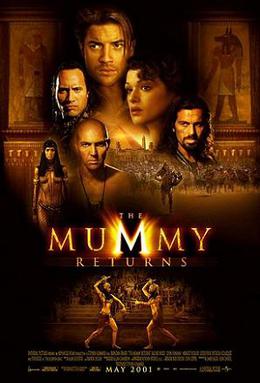
Mummy Pimp: Pointless But Good

Why aren't Brendan Fraser, Rachel Weiss and Oded Fehr in EVERY movie? Patricia Velasquez and Arnold Vosloo can come along, too. And heck, why leave out John Hannah and Kevin J. O'Connor?

One thing you gotta give up for The Mummy Returns: the fight scenes are fan-bleeding-tastic. And I'm a sucker of how Sommers stages his stuff. That fight scene in the O'Connell house is set up BEAUTIFUL.

LIGHNTING FLASH LIGHTNING FLASH

"We'll take the box."

EVELYN TAKES A BAD-ASS PILL

"I don't think so."

LIGHTNING FLASH LIGHTNING FLASH, BAD GUYS POUR IN

"Then we'll kill you, and take the box anyway."

ENTER ODED FEHR

"I think not."


Come on! If you're not on board with that, go down to the community center and buy yourself some bingo cards. Get one of those stamper things so you can run four or five cards at the same time.

Because then there's a totally awesome fight scene, and then machine guns go off, and capes swirl, and cars go zoom zoom crash roar, and more machine guns, and mummies and guys getting ratchetted backwards into pools of fire, and explosions, and Rachel Weiss and come on.

Look, I know what you're going to say. You're going to say that The Mummy Returns is insipid. Stupid. Derivative. Way too complicated for its own good (WHY do they make a big deal about somebody opening the chest so the Mummy can suck them dry? Good grief). Stupid. Tedious. Full of fake-looking CGI effects. Featuring bad astronomy. Stupid.

I can't argue with any of that. And yet I am helpless before this film. I LOVE this film. I just love watching Fraser and Weiss and Fehr banter and throw punches and shoot things and scream a lot. They're all so very charming.

And they do a LOT. A lot happens in this film. And while that kind of LOOKS like a problem, I think it's not really the problem. I've spoken about the films of Tsui Hark and how they seem so incredibly stuffed full of stuff, and that's a good thing. There, it works. Here, Sommers does too much.

Part of the problem is the large amount of NEEDLESS stuff. The story itself isn't all that complicated, but there's all these subplots and goofy things taking up your screen time. Compare it with Peking Opera Blues. I've seen that film twenty times or more, but I still don't think I could relate the plot to you. I don't really know what it's about, but I do know that it's totally awesome.

On the other hand, it doesn't feature Oded Fehr with a hawk:


That bit always cracks me up. Half way through the film, and Fehr's already several times cooler than anyone you know, and he just sort of casually turns around and says, "Oh yeah, AND I have this trained hawk that comes whenever I call."

That's pimp. Oded Fehr is like the Ancient Guardian Pimp-Master Supreme. And he's got a few thousand bad-ass characters that can show up and just ride around Egypt for a few days. With, you know, swords and turbans and trained hawks (named Horus -- bet there's a lot of hawks named Horus over Egypt-land). That's just how the Pimp-Master Supreme rolls.

It's like Superman mentioning, just in passing, as he's rattling off all his super-powers, that he's also a cordon blue chef. Pimp.

I know, I know. You could cut an hour out of this movie and miss none of it. Especially if it was the hour featuring that kid.

(WHY do people put children in their movies? It's a mystery.)

Damn, but this is scattered. I haven't even gotten to the pygmy mummies swinging on vines.

Or THAT GUY.

Okay, I don't know if anyone else in the world has ever noticed this, but like I say, I LOVE this movie. So there's this guy who shows up right at the start. He's just some mook in a red turban, pointing a gun at the sub-bad guys (the Cockney adventurers (who I would TOTALLY go see a movie about, damn that's a good idea Corey)). THAT GUY shows up again and again throughout the movie, and every time he just keeps avoiding death. He chucks a knife at O'Connell that our hero catches and flings back, and THAT GUY leans aside and lets the knife take his buddy in the chest. He empties his Luger at O'Connell and then ducks the return fire AGAIN.

This goes on for the whole move. THAT GUY keeps avoiding certain death again and again, until at last he is unable to cheat it any longer. But I'm pretty sure he's the very last red-turban mook to go down. Go watch it, you'll see. He's got no lines, but he's one of my favourite characters in the whole picture.

And he's one of the things that redeems this hopeless, messy, stupid stupid stupid picture for me. I mean, there's no earthly reason for it. Why keep having this guy narrowly avoid death again and again? Nobody notices who watches the film once. Or even ten times.

(Yes, yes I have watched it more than ten times)

There's no PURPOSE to it, and THAT'S what lurks around at the heart of this film that touches me. Somebody (let us assume Mr. Sommers) just put that running gag in the picture because it amused them. And whatever other qualities this film may possess, it at least feels like a film made by people who really WANTED to make it.

It's two o'clock in the morning and I'm only half-way through, and I know this isn't making a lot of sense, but hell. Neither does The Mummy Returns and you sat through that didn't you?

Well, I did.

GIANT NAZI ROBOT

Holy crap.

JaqPike just sent me this (via TechEBlog):


If you need encouragement to watch this: GIANT NAZI ROBOT ATTACKS PEARL HARBOUR, FIGHTS SQUADRON OF MUSTANGS, THEN COOL SHIT REALLY STARTS HAPPENING. I really can't say much more about it, except, once again, the coolest movies nowadays ain't coming out of movie studios.

Oh, there's problems in this clip. The "story" needs work, the performances are goofy, yada yada yada. But come on. A GIANT NAZI ROBOT ATTACKS PEARL HARBOUR. What more do you need?